
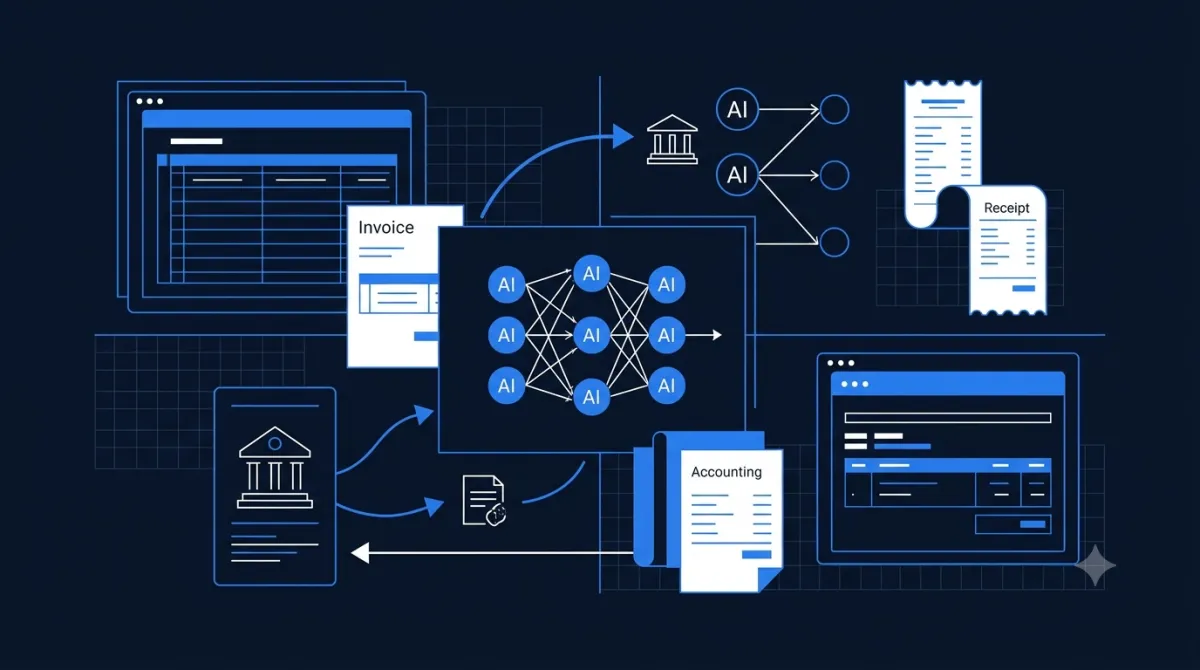
Excerpt: Most businesses compare AI bookkeeping platforms by feature lists instead of operational impact. This framework shows how to evaluate automation, integrations, oversight, and governance so you choose software that saves meaningful time rather than adding another AI novelty.
Bookkeeping software demonstrations are designed to impress. Chat interfaces answer financial questions, dashboards generate polished summaries, and AI assistants promise to automate accounting.
Yet these features rarely determine whether your finance team saves five minutes—or five hours—each week.
The better question is simple:
Which repetitive bookkeeping workflow disappears after adopting this software?
That mindset leads to far better purchasing decisions than comparing long feature checklists.
Evaluate Workflows Before You Evaluate AI
Every bookkeeping process contains repetitive work.
The highest-value platforms reduce manual effort in predictable, reviewable workflows rather than replacing professional judgment.
The greatest productivity gains usually come from automation such as:
- Automatic transaction categorization
- Receipt OCR and data extraction
- Bank reconciliation
- Invoice processing
- Expense matching
- Duplicate transaction detection
- Vendor recognition
- Cash-flow forecasting
- Basic anomaly detection
By contrast, these capabilities often provide less immediate operational value:
- AI chat assistants
- Natural-language search
- Automatically generated financial summaries
- Generic business recommendations
A practical evaluation question is:
If this software removed one hour of bookkeeping every day, which workflow would disappear?
If the answer isn't obvious, the platform may be optimizing demonstrations instead of operations.
What Strong AI Bookkeeping Platforms Consistently Do Well
The best AI bookkeeping software for small business 2026 shares a common philosophy: automate repetitive work while keeping humans responsible for accounting decisions.
Instead of hiding automation behind opaque AI, mature platforms expose uncertainty and make corrections easy.
Look for capabilities such as:
| Capability | Why it Matters |
|---|---|
| Confidence scores | Indicates when AI is uncertain. |
| Audit trails | Makes every automated decision traceable. |
| One-click corrections | Reduces cleanup time. |
| Learning from edits | Improves future categorization accuracy. |
| Consistent accounting rules | Prevents inconsistent bookkeeping. |
| Explainable recommendations | Helps accountants validate AI output. |
A single misclassified transaction can affect budgeting, taxes, profitability analysis, and financial reporting months later.
Good bookkeeping software accelerates review—not blind approval.
Compare Platforms Using Five Evaluation Dimensions
Feature lists often exaggerate small differences while ignoring operational impact.
A structured evaluation framework makes competing products easier to compare.
| Evaluation Area | Questions to Ask | Why It Matters |
|---|---|---|
| Workflow Automation | Which bookkeeping tasks are fully automated? | Determines measurable time savings. |
| Integration Depth | Does it connect to banks, payroll, ecommerce platforms, and payment processors? | Eliminates manual imports. |
| Human Oversight | Can users review and override AI decisions? | Prevents automation errors. |
| Transparency | Are recommendations explained and traceable? | Supports audits and compliance. |
| Security & Governance | How is financial data stored, retained, and protected? | Protects sensitive financial information. |
Notice that none of these dimensions asks whether a platform has the "smartest AI."
Businesses benefit more from reliable workflows than impressive demonstrations.
Integration Quality Usually Matters More Than Smarter AI
Bookkeeping rarely exists in isolation.
Financial information moves between:
- Banks
- Payroll providers
- Ecommerce platforms
- Payment processors
- Expense management software
- Invoicing systems
- CRM platforms
Weak integrations create manual reconciliation work that quickly outweighs AI productivity gains.
During evaluations, ask questions such as:
- Which banks are supported?
- How frequently are transactions synchronized?
- How are conflicting imports handled?
- Can accounting rules override AI decisions?
- Is historical transaction data preserved during migration?
- How easily can accountants export records?
Saving five minutes through automated categorization provides little value if employees spend thirty minutes correcting synchronization issues.
The strongest automation connects existing workflows instead of forcing businesses to redesign them.
Understand the Tradeoffs Before Buying
Every automation decision involves compromises.
Understanding those tradeoffs leads to more realistic purchasing decisions.
| AI-First Platforms | Traditional Accounting Software |
|---|---|
| Faster routine bookkeeping | Mature accounting functionality |
| Less manual data entry | Familiar accountant workflows |
| Better scalability | Broad regulatory support |
| Higher automation | Predictable processes |
| Variable accuracy during onboarding | More repetitive manual work |
| May provide limited explainability | Lower automation potential |
Another consideration is data governance.
Financial records contain highly sensitive business information.
Before adopting any platform, verify:
- Where financial data is processed
- How long customer data is retained
- Whether customer information contributes to future AI model training
- Available compliance certifications
[VERIFY]
Suggested searches:
- SOC 2 AI bookkeeping software
- AI bookkeeping software security documentation
- AI bookkeeping software privacy policy
- AI bookkeeping software data retention policy
Match the Platform to Your Business Workflow
No product is universally best.
Different businesses prioritize different bookkeeping challenges.
| Business Type | Typical Priority |
|---|---|
| Freelancers | Automated invoicing and receipt capture |
| Ecommerce companies | Payment reconciliation and inventory synchronization |
| Professional service firms | Expense management and project profitability |
| Growing startups | Multi-user approvals, forecasting, financial controls |
Before comparing vendors, document your existing bookkeeping process.
Identify:
- Which activities consume the most employee time.
- Which tasks generate the most corrections.
- Which processes rely on repetitive manual work.
- Which integrations are essential to daily operations.
Only then should individual platforms be evaluated.
This workflow-first approach consistently produces better purchasing decisions than comparing feature matrices.
For readers building broader AI operations, TipJournal's guides on Testing AI Agents in Production and Shadow AI governance provide complementary frameworks for evaluating automation reliability beyond finance.
Ultimately, the most effective AI bookkeeping software for small business 2026 is the platform that quietly removes operational friction, integrates naturally into existing financial systems, and gives accountants confidence that automation is improving accuracy—not simply making bookkeeping faster.