
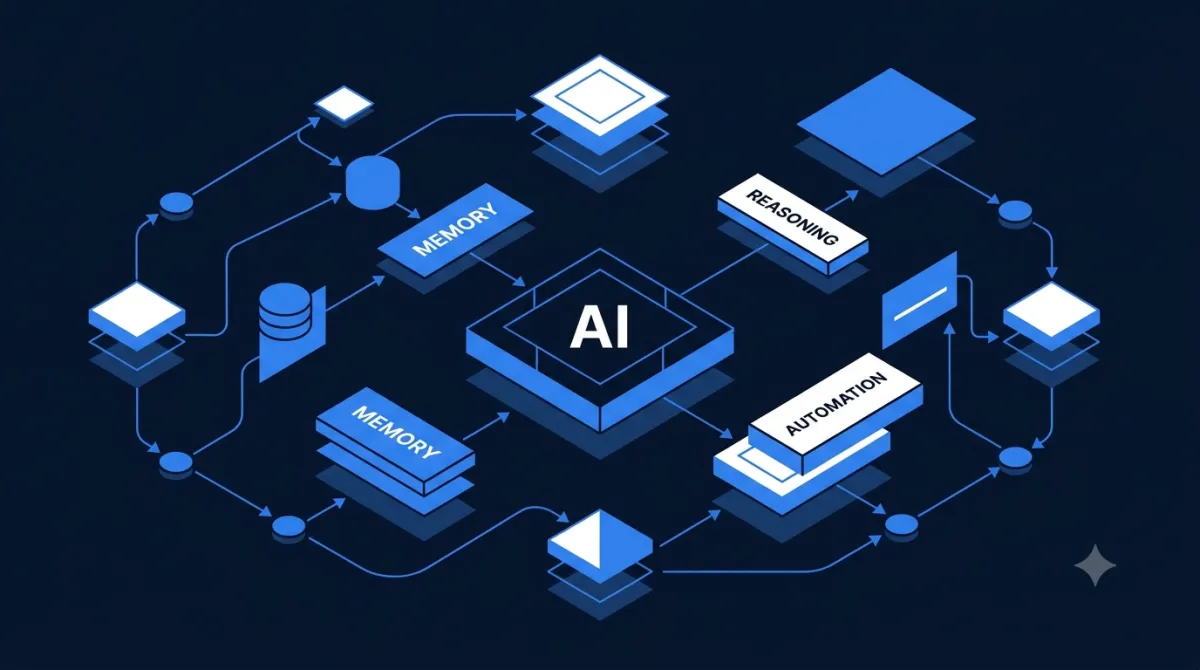
The promise of personal AI agents has shifted from simple chatbot interactions to software capable of planning, remembering context, and completing multi-step tasks. Google's Gemini Spark represents another step toward that vision, but adopting an AI agent successfully depends far more on workflow design than on model capability alone.
Many teams evaluate AI agents by asking whether they can automate a task. A better question is whether the surrounding workflow is reliable enough to trust. This Gemini Spark AI agent Google guide focuses on designing dependable personal AI workflows, identifying where autonomous agents create real value, and avoiding common implementation mistakes.
Stop Thinking About Individual Prompts and Start Designing Systems
The biggest misconception surrounding AI agents is that better prompts produce better automation. In practice, prompts are only one component of a reliable system.
A dependable workflow typically combines:
- clearly defined objectives
- structured inputs
- controlled tool access
- validation checkpoints
- human approval where risk justifies oversight
An AI agent that can browse the web, search internal documents, draft reports, and schedule follow-up actions introduces significant flexibility. It also introduces additional failure modes. Every new capability expands the range of possible errors unless supported by appropriate guardrails.
For practitioners, the objective should be reducing uncertainty rather than maximizing autonomy. The most successful deployments automate repetitive reasoning while reserving judgment-intensive decisions for humans.
Instead of asking, "Can the agent complete this task?" ask, "Can the workflow recover gracefully when the agent is wrong?"
That mindset often determines whether an AI system becomes a trusted assistant or an abandoned experiment.
Where Gemini Spark AI Agent Google Fits Into Daily Work
Not every workflow benefits from an autonomous agent. Tasks that follow predictable sequences with well-defined success criteria tend to produce the strongest results.
Examples include:
- collecting information from multiple trusted sources
- summarizing technical documentation
- preparing recurring reports
- organizing project knowledge
- drafting structured content for review
- maintaining research notes
These activities involve significant cognitive effort but relatively low business risk. Even when the agent produces imperfect outputs, human review remains efficient because the structure is already in place.
Higher-risk activities—such as financial approvals, legal analysis, or production infrastructure changes—require stricter validation and often remain unsuitable for fully autonomous execution.
Rather than replacing human expertise, AI agents should reduce the time spent on predictable knowledge work while keeping experts responsible for final decisions.
Reliability Depends More on Workflow Architecture Than Model Quality
Model improvements receive the most attention, yet workflow architecture often has a greater impact on real-world reliability.
A practical architecture typically includes five stages:
- Gather information.
- Verify sources.
- Execute reasoning.
- Produce structured outputs.
- Request human approval when confidence is limited.
This staged approach makes failures easier to detect and isolate. If the information gathering step produces incomplete context, downstream reasoning becomes easier to diagnose than if every action occurs inside a single prompt.
Memory also deserves careful consideration. Persistent context can improve continuity across tasks, but outdated or incorrect information may silently influence future outputs. Periodic review and controlled memory updates help maintain accuracy over time.
The goal is not maximum automation. It is predictable automation.
The Tradeoffs Every Practitioner Should Evaluate
AI agents introduce meaningful advantages, but they also create new operational challenges.
Potential strengths include:
- reduced repetitive work
- faster information synthesis
- consistent execution of routine processes
- improved personal productivity
- easier knowledge organization
Potential limitations include:
- incorrect reasoning despite confident responses
- dependency on external tools and data quality
- unpredictable behavior in ambiguous situations
- increased oversight requirements
- evolving product capabilities that may change over time
No single AI agent performs equally well across every task. The quality of connected tools, available context, and workflow design often matters more than differences between foundation models.
Organizations evaluating personal AI agents should define success metrics before deployment. Examples include time saved per task, reduction in manual steps, review effort, and user satisfaction rather than simply measuring output volume.
A Practical Framework for Designing Personal AI Agents
Before integrating an AI agent into daily work, evaluate each workflow using a structured checklist.
Define the objective
Focus on one measurable outcome. Avoid assigning broad responsibilities such as "manage my work."
Limit available tools
Only grant access to resources required for the specific workflow. Smaller capability surfaces generally produce more predictable behavior.
Create verification checkpoints
Require the workflow to validate retrieved information before generating recommendations whenever possible.
Standardize outputs
Use consistent templates, structured summaries, or predefined formats. Predictable outputs simplify downstream review.
Measure performance continuously
Track practical metrics such as completion time, correction frequency, and manual intervention rather than relying solely on subjective impressions.
These principles remain useful regardless of which AI platform eventually becomes part of your workflow.
The Future Belongs to Reliable Workflows, Not Smarter Chatbots
The next generation of AI productivity will be defined less by larger language models and more by dependable systems that combine reasoning, memory, tools, and human oversight.
Google's Gemini Spark reflects the broader industry movement toward personal AI agents capable of coordinating complex tasks instead of answering isolated questions. [VERIFY] Search query: Gemini Spark official documentation personal AI agent capabilities.
For practitioners, the competitive advantage will not come from adopting every new AI product. It will come from building workflows that remain understandable, measurable, and resilient as models evolve.
If you're evaluating Gemini Spark AI agent Google for production use, begin with a narrowly scoped workflow, define clear success criteria, and expand only after the system demonstrates consistent reliability. Sustainable automation is achieved through disciplined workflow design, not autonomous behavior alone.