
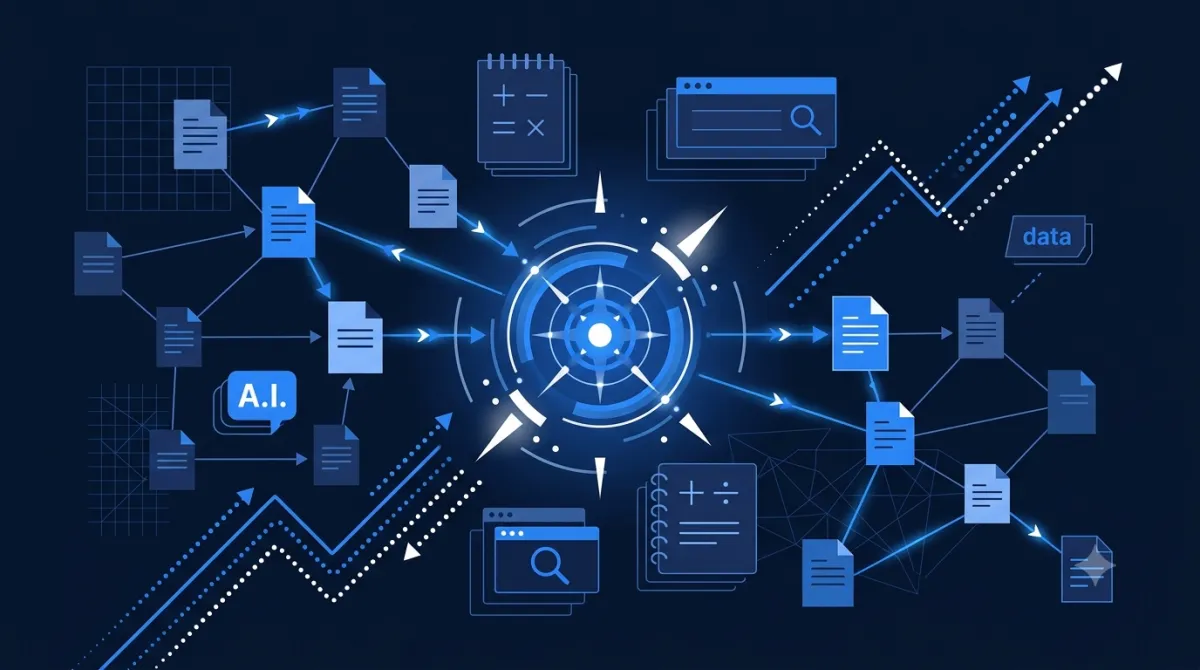
NotebookLM Workflow: Build an AI Research System That Scales With Your Knowledge
Excerpt: Information overload isn't caused by having too many documents—it's caused by having no repeatable system for organizing them. This guide explains how to build a NotebookLM workflow that improves research quality through better knowledge architecture, source management, and review processes rather than relying on AI alone.
Most professionals don't waste time because information is unavailable.
They waste time because information is scattered.
Technical documentation lives in shared drives, meeting notes disappear into collaboration tools, research papers accumulate in cloud storage, and design decisions become buried inside chat histories.
A well-designed NotebookLM workflow addresses that fragmentation by turning curated document collections into project-specific knowledge bases instead of isolated files.
The objective isn't simply finding answers faster.
It's building a research system that continues to produce reliable answers as documentation grows.
Treat NotebookLM as a Knowledge Layer Instead of Another Chatbot
One of the biggest mistakes users make is approaching NotebookLM like a general-purpose conversational AI.
That limits its value.
NotebookLM performs best when documents—not the model—become the primary source of truth.
Instead of asking questions against a model's general knowledge, you ask questions against carefully curated project documentation.
That changes how research should be organized.
Rather than creating one massive notebook, separate work into focused knowledge domains.
Examples include:
- Product requirements
- API documentation
- Architecture decisions
- Competitor research
- AI model evaluations
- Customer research
- Internal strategy documents
Smaller notebooks reduce irrelevant context while making relationships between documents easier to discover.
The goal is not collecting more files.
The goal is maintaining clearer knowledge boundaries.
Design a NotebookLM Workflow Around Research Decisions
Uploading documents is only the beginning.
The real productivity gains come from following a repeatable research process.
A practical workflow looks like this.
| Stage | Purpose |
|---|---|
| Collect | Gather authoritative documents. |
| Organize | Separate material into focused notebooks. |
| Summarize | Generate structured understanding of each source. |
| Compare | Identify recurring themes and contradictions. |
| Produce | Create reports or structured outputs for review. |
| Maintain | Archive obsolete material and update active notebooks. |
This process transforms passive storage into active knowledge management.
For example, an engineering team evaluating multiple AI frameworks might maintain independent notebooks for architecture documentation, benchmark research, implementation notes, and vendor documentation.
Instead of repeatedly searching dozens of PDFs, they explore relationships across trusted sources while keeping conclusions grounded in project evidence.
As documentation grows, consistency becomes more valuable than volume.
Source Quality Determines Knowledge Quality
AI cannot compensate for weak documentation.
If notebooks contain outdated specifications, conflicting notes, or duplicated material, the resulting summaries inherit those problems.
Before importing documents, review every source.
Ask:
- Is it authoritative?
- Is it current?
- Does it duplicate existing material?
- Does newer documentation replace it?
- Is it still relevant to active work?
Primary sources generally deserve greater weight than summaries.
Examples include:
- Official documentation
- Technical specifications
- Design documents
- Published research
- Internal engineering decisions
Secondary summaries remain useful, but they should complement—not replace—the original material.
Reliable AI begins with reliable evidence.
Build Review Loops Into Every NotebookLM Workflow
Many teams incorrectly treat AI-generated summaries as completed work.
In practice, research outputs require lightweight validation before influencing important decisions.
Effective review checkpoints include:
- Comparing summaries with original documents
- Verifying technical terminology
- Confirming conclusions across multiple sources
- Identifying missing evidence
- Recording unresolved questions
These reviews become increasingly valuable as projects evolve.
Requirements change.
Documentation is updated.
Previous assumptions become obsolete.
Without periodic validation, knowledge bases slowly drift away from reality.
The objective is confidence, not convenience.
Knowledge Bases Require Governance to Scale
As document collections expand, maintenance becomes as important as collection.
A sustainable research environment benefits from a few consistent practices.
Separate active and archived projects
Current work should remain isolated from historical material to reduce unnecessary context.
Standardize document naming
Consistent naming conventions simplify searching, maintenance, and long-term organization.
Schedule maintenance
Review notebooks periodically to:
- Remove obsolete documentation
- Replace outdated specifications
- Merge duplicate sources
- Refresh critical references
Record important decisions
When significant conclusions are reached, document them explicitly.
Future summaries should reinforce documented reasoning rather than reconstruct it from scattered evidence.
Knowledge systems remain useful only when they evolve alongside the projects they support.
Better Organization Creates Better AI Research
AI dramatically reduces the effort required to summarize large document collections.
It does not replace disciplined information management.
NotebookLM delivers the greatest value when it supports a structured research process built around trusted sources, clear organization, repeatable reviews, and ongoing maintenance.
[VERIFY]
Suggested searches:
- NotebookLM official documentation
- NotebookLM supported sources
- NotebookLM enterprise documentation
- NotebookLM Google Workspace features
If you're building a NotebookLM workflow, begin with a single well-defined project rather than importing every document you own. Establish naming standards, validate important outputs against original sources, and expand only after the workflow proves reliable. Teams that achieve the greatest productivity gains are rarely those with the largest knowledge bases—they are the ones with the most disciplined systems for organizing and maintaining them.
For readers building broader AI productivity systems, TipJournal's guides on AI agent production workflows, continuous validation pipelines, and Shadow AI governance provide complementary practices for managing knowledge, automation, and organizational trust.