
Testing AI Agents in Production: The Continuous Validation Pipeline You Actually Need
A CI pipeline that flunks on every model update isn't protecting your users — it's lying to you. Standard unit tests assert that input X yields exact output Y. Autonomous agents don't work that way. They stochastically select reasoning paths, adjust plans mid-execution, and invoke tools in non-deterministic sequences. Forcing rigid code assertions onto this architecture guarantees flaky builds, false positives, and the worst outcome of all: an agent that passes every test while hallucinating payloads inside a production tool call.
Engineering leads running multi-agent systems need to stop patching CI and start building validation pipelines that evaluate behavioral boundaries, token budgets, and semantic accuracy at scale. Here's the architecture that actually works.
Why Testing AI Agents in Production Demands Three Layers
A production agent validation pipeline treats the agent as a live system with behavioral guardrails, not a static script. The architecture evaluates execution across three tiers: code-level integration, tool-calling schema validation, and semantic output alignment.
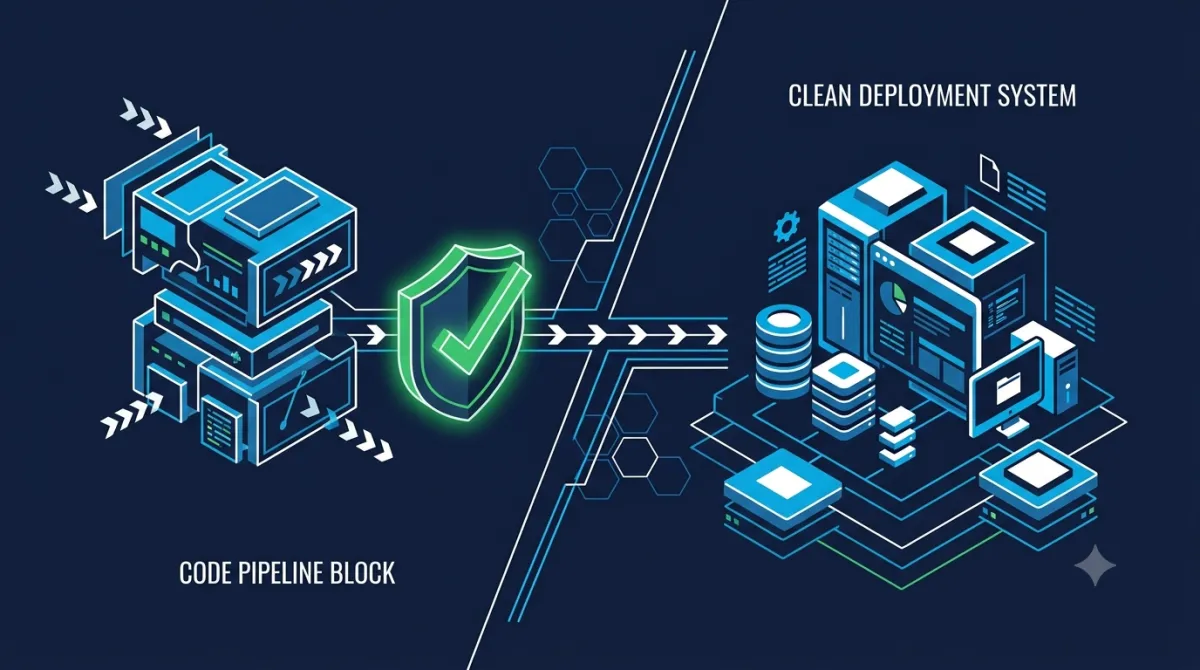
[Trigger Commit] → Layer 1: Deterministic Lint & Mock → Layer 2: Syntactic Tool Assertions → Layer 3: LLM-as-a-Judge Eval → [Merge to Main]
The pipeline fires on every pull request. Unlike standard deployment flows, the execution environment needs dedicated vector database instances and sandboxed tool endpoints where the agent can invoke third-party APIs without touching production state. This isolation matters: an optimization to one sub-agent's routing logic should never silently degrade the coordination cluster downstream.
Schema Validation Catches What Logs Miss
Layers 1 and 2 handle structural integrity. We can't predict an LLM's exact text, but we can — and must — enforce the structure of its tool invocations.
Layer 1 runs standard linting and static analysis on the orchestration code (LangChain, AutoGen, or custom Python runtimes). Layer 2 executes the agent against deterministic mocks, intercepting JSON payloads and validating them against strict schema definitions.
from pydantic import BaseModel, Field, ValidationError

class DatabaseQuerySchema(BaseModel):
    query_string: str = Field(..., description="SQL query generated by the agent.")
    row_limit: int = Field(default=100, le=500, description="Hard limit to prevent token overflow.")

def verify_agent_action(tool_payload: dict):
    try:
        validated_action = DatabaseQuerySchema(**tool_payload)
        return True
    except ValidationError as e:
        log_pipeline_failure(reason="Malformed tool schema invocation", errors=e.json())
        return False
An agent that submits an invalid SQL statement or drops a required parameter fails immediately at the structural layer — before it burns expensive LLM tokens downstream. This is cheap, fast, and catches the failures that post-deployment logs reveal too late.
Semantic Evaluation: Grading Reasoning, Not Strings
Once structural integrity checks pass, the pipeline advances to semantic evaluation. This layer uses a dedicated evaluation model (GPT-4o or Claude 3.5 Sonnet in deterministic configurations) to judge the agent's reasoning against a curated dataset of 50–100 high-intent scenarios. Each scenario pairs an input prompt with evaluation criteria scored across three rubrics:
- Faithfulness: Does the response rely only on provided context, or does it fabricate external information?
- Relevance: Does the output address the user's actual intent, or does it loop through irrelevant tool calls?
- Boundary Adherence: Did the agent refuse jailbreak attempts and stay within data-access limits?
The judge outputs a score between 0.0 and 1.0 per rubric. If the average drops below an established baseline — 0.85 is a reasonable starting threshold — the pull request is blocked. This catches regressions that schema validation never would: subtle reasoning shifts where the agent still calls the right tools but produces worse answers.
Killing Loop Cascades Before They Kill Your Budget
The most expensive operational failure in agent systems is the loop cascade: an agent retries an action, misinterprets the error, and generates an unconstrained chain of API calls. This drains token budgets fast and can exhaust rate limits on dependent services.
Every agent validation pipeline needs hard execution limits enforced at the runtime container level:
| Constraint | Recommended Default | What It Prevents |
|---|---|---|
| Max reasoning iterations | 5–7 turns per scenario | Unbounded Thought-Action-Observation loops |
| Token budget per query | 50,000 cumulative tokens | Single query exhausting pipeline budget |
| Container timeout | 30 seconds max execution | Hung processes blocking CI runners |
⚠️ Operational Warning: Never run agent validation against live, unthrottled production API keys. Map all tool execution to rate-limited staging endpoints with isolated token budgets.
The Tooling Landscape in 2026
Building a validation pipeline from scratch means stitching together orchestration layers, evaluation runners, and CI integrations. The ecosystem has matured enough that you shouldn't have to.
Promptfoo and DeepEval are the strongest CLI-driven options for most teams. Both integrate natively with GitHub Actions and GitLab CI, support YAML-defined evaluation datasets, and render rubric dashboards inside pull request interfaces. Promptfoo has a slight edge for teams already running model-comparison benchmarks; DeepEval offers deeper built-in metrics for hallucination detection.
For organizations running complex multi-agent topologies that need session playback and behavioral sandboxing, the options are thinner. Most teams end up building custom harnesses around evaluation runners — which is precisely why starting with Promptfoo or DeepEval and layering domain-specific scenarios on top is the pragmatic path.
The Migration Path Forward
Stop writing raw unit test assertions for LLM output logic. It's not protecting you.
Start with JSON schema validation on every tool-calling mechanism. This catches the majority of syntactic failures at near-zero cost. Then introduce a lightweight semantic testing suite — Promptfoo or DeepEval work well — targeting your top 20 enterprise edge cases as the initial evaluation dataset. Run it alongside your existing CI until you trust the scores, then gate merges on the semantic baseline.
This is how teams testing AI agents in production ship updates weekly without silent regressions: validate structure mechanically, grade reasoning semantically, and enforce budget limits at the container level. Everything else is infrastructure you can layer on later.