
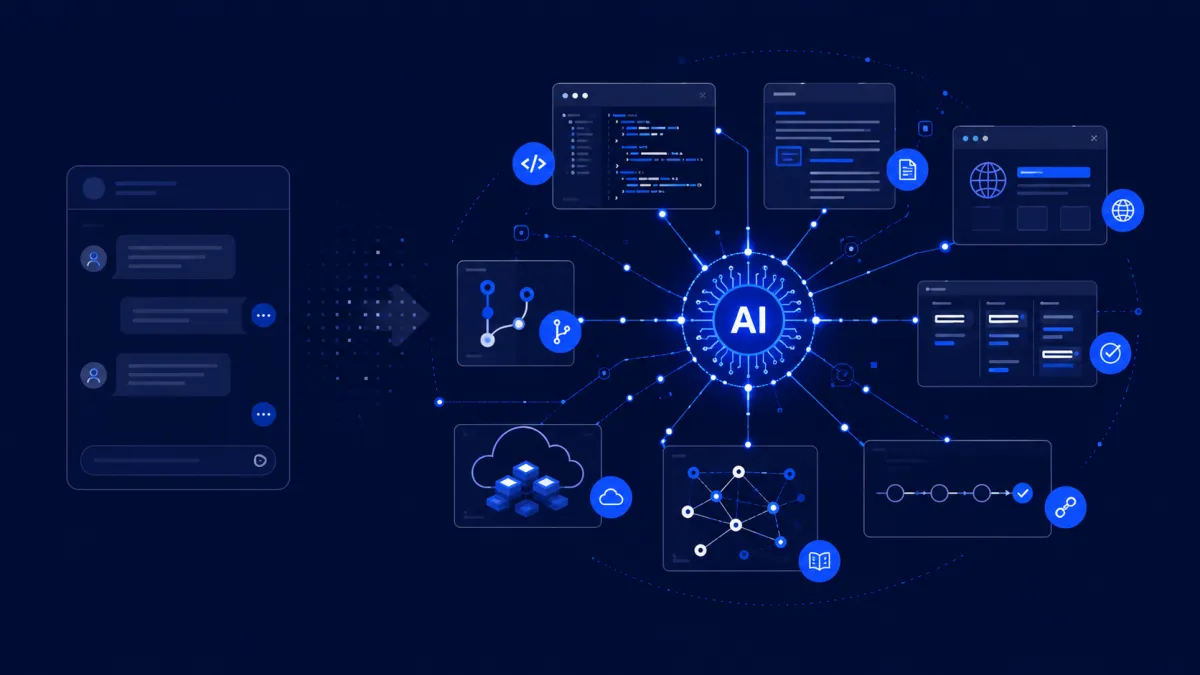
The phrase "AI employee" has become one of the technology industry's favorite narratives.
Every major product launch promises systems that can plan projects, write code, analyze documents, answer customers, and complete increasingly sophisticated tasks with little human intervention. It's an appealing vision because it suggests organizations can scale expertise as easily as they scale cloud infrastructure.
But most companies aren't looking for another employee.
They're looking for a better way to work.
The next generation of AI isn't replacing professionals. It's becoming a persistent collaborator that remains connected to projects, understands context, and contributes throughout the workday. Whether it's embedded in an IDE, a browser, a document editor, or a project management platform, AI is gradually shifting from an assistant you consult into a coworker that participates.
That distinction matters because it changes how organizations should evaluate AI—not by asking how many jobs it can replace, but how effectively it amplifies the people already doing them.
Stop Thinking About AI as Software
For decades, software has been transactional.
You open an application, complete a task, save your work, and close it. Early generative AI followed the same pattern.
Open a chatbot.
Write a prompt.
Receive an answer.
Copy the result.
Repeat.
That interaction model made AI widely accessible, but it also introduced a recurring inefficiency. Every conversation begins with the AI knowing almost nothing about the work already in progress.
Developers repeatedly explain their codebase.
Writers summarize projects they've been working on for weeks.
Analysts upload the same reports multiple times.
The friction isn't caused by model intelligence. It's caused by the interface.
Modern AI platforms are increasingly designed to reduce that friction by remaining connected to the work itself. Rather than acting as standalone applications, they're becoming integrated collaborators that retain context across longer workflows.
This is a fundamental shift in how people interact with AI.
Context Is Becoming More Valuable Than Intelligence
The industry has spent years comparing reasoning benchmarks, coding scores, and mathematical performance.
Those metrics remain important, but they explain only part of what makes AI useful in practice.
A highly capable model still struggles if every interaction starts from zero.
Productive collaboration depends on continuity.
That continuity comes from context:
- repository history
- project documentation
- previous decisions
- organizational standards
- shared terminology
- ongoing conversations
When AI understands these elements, it spends less time reconstructing problems and more time contributing meaningful work.
This explains why many recent AI products emphasize persistent workspaces, memory, repository awareness, and long-running sessions instead of simply advertising larger models.
As foundation models continue to converge in capability, contextual awareness may become one of the strongest competitive advantages in enterprise AI.
The Best AI Coworkers Participate Instead of Waiting
A traditional assistant responds when asked.
A coworker contributes throughout a project.
That distinction is becoming increasingly important.
Modern AI systems are beginning to assist across an entire workflow rather than isolated requests.
A software engineer might collaborate with AI while:
- planning a feature
- reviewing pull requests
- debugging production issues
- writing documentation
- generating tests
- explaining architectural decisions
A marketing team might rely on AI to maintain editorial consistency, summarize research, organize campaign assets, and identify gaps before publication.
In both cases, AI isn't replacing expertise.
It's reducing repetitive cognitive work so professionals can spend more time making strategic decisions.
The greatest productivity gains often come not from better answers but from fewer interruptions.
Trust Will Decide Enterprise Adoption
Continuous collaboration introduces challenges that simple chatbots rarely faced.
If AI remains connected to ongoing work, organizations must answer questions about:
- permissions
- memory retention
- security
- compliance
- auditability
- human oversight
Who decides what AI can access?
How long should project context be retained?
How should organizations review decisions influenced by AI?
These questions are becoming just as important as model performance.
Enterprise adoption will depend on trust as much as intelligence.
Organizations are unlikely to embrace persistent AI unless they can control how information is stored, shared, and used throughout the software lifecycle.
The companies that solve governance will have a significant advantage over those focused solely on model capability.
The Competitive Battle Is Moving Beyond Models
For the past several years, AI competition centered on which company built the most capable language model.
That race continues, but it's becoming less decisive.
Organizations increasingly compare platforms based on how well they integrate into existing workflows.
Can AI remain aware of ongoing projects?
Can it collaborate across multiple applications?
Does it reduce context switching?
Can it work alongside existing development, research, and business processes?
These questions determine daily productivity far more than small differences in benchmark performance.
The winning platforms won't necessarily have the smartest models.
They'll have the most useful workflows.
The Future Belongs to Teams, Not Autonomous Systems
Predictions about AI replacing knowledge workers often assume that work consists primarily of producing outputs.
In reality, most professional work revolves around collaboration.
Engineers debate architecture.
Designers iterate with stakeholders.
Writers refine ideas with editors.
Researchers challenge assumptions together.
These interactions create context that no benchmark can easily measure.
The next generation of AI will add value by participating in these collaborative processes rather than attempting to replace them.
Instead of acting as autonomous employees, AI systems are becoming specialized teammates that contribute continuously while leaving judgment, accountability, and final decisions to humans.
That model is not only more realistic—it is already emerging across software development, knowledge work, and enterprise productivity.
Final Recommendation
The idea of an "AI employee" makes for compelling headlines, but it oversimplifies how organizations derive value from artificial intelligence.
The more meaningful transformation is the rise of the AI coworker: systems that remain connected to projects, understand evolving context, and contribute throughout the workday without replacing human expertise. They reduce repetitive work, preserve institutional knowledge, and make collaboration more efficient rather than more autonomous.
For engineering leaders, founders, and knowledge workers, the strategic question is no longer whether AI can perform individual tasks. It's whether AI can become a trusted participant in the team's workflow.
Organizations that answer that question well will gain far more than faster automation. They'll build workplaces where human expertise and AI capabilities evolve together instead of competing for the same role.