
The era of prompt-and-response AI is officially behind us. In 2026, the paradigm has shifted entirely to Agentic Workflows—systems that don’t just write your emails or analyze your data, but actually take over your screen, keyboard, and browser to execute complex tasks from start to finish.
The market has consolidated around three distinct philosophies represented by the industry’s giants: Anthropic’s Claude Computer Use, OpenAI’s Operator, and Google’s Gemini Browser Agent.
For digital professionals, developers, and enterprise architects, choosing the right ecosystem is no longer about which LLM writes better code; it’s about which agent can be trusted to run your digital infrastructure. Here is how the three titans stack up in the 2026 showdown.
1. Anthropic’s Claude Computer Use: The Raw OS Purist
Anthropic shocked the industry by bypassing the browser entirely and training Claude to look at a virtual desktop screen, move a cursor, and type commands like a human.
How It Works
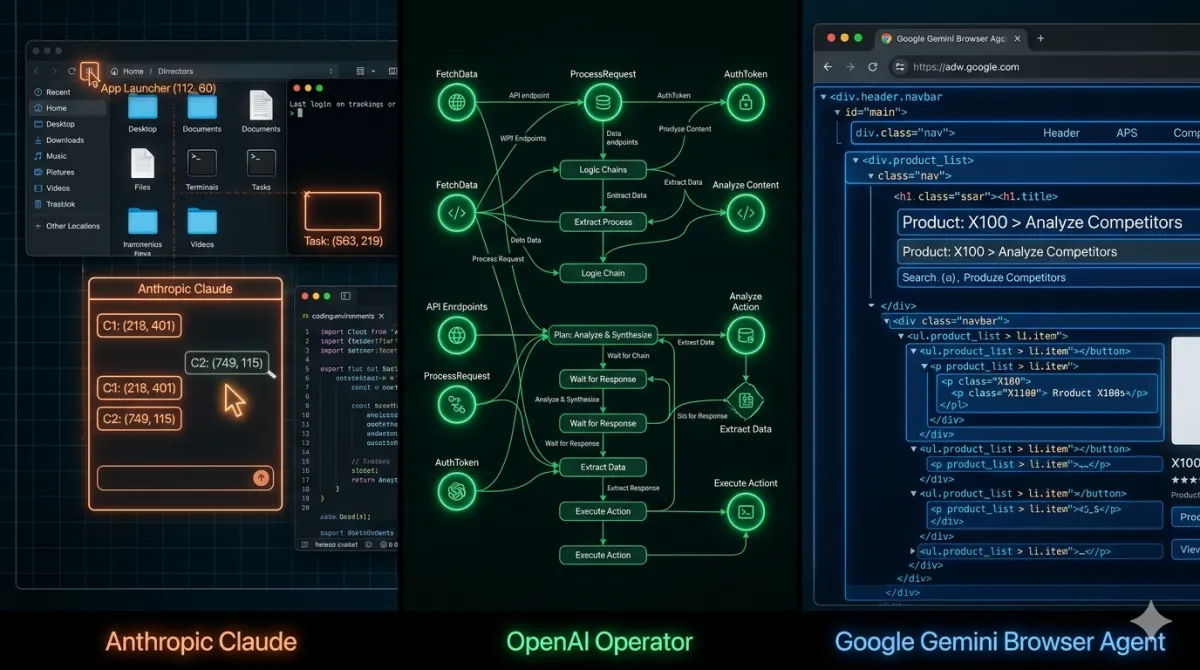
Claude takes continuous screenshots of a virtual machine environment, perceives the pixel coordinates of UI elements, and issues OS-level keyboard and mouse commands. It doesn’t rely on backend APIs or underlying DOM structures; if a human can click it, Claude can click it.
Best For
- Legacy Desktop Software: Interacting with local apps, heavy IDEs, and internal enterprise software that lacks APIs.
- Complex Multi-App Workflows: Moving data seamlessly from a local Excel spreadsheet into a legacy CRM, then generating a report via a desktop PDF editor.
The Verdict: Claude is the ultimate "generalist" operator. It treats your computer like a digital canvas, making it incredibly versatile but resource-heavy.
2. OpenAI Operator: The Workflow Maestro
OpenAI’s Operator represents a highly polished, proactive assistant designed to live natively alongside the user, mastering both browser environments and API-driven execution.
How It Works
Operator relies on a hybrid architecture. While it can navigate UI elements visually, it heavily leverages structural web data, deep API integrations, and OpenAI's advanced reasoning capabilities ($o1$ and $o3$ architectures) to plan steps before executing them. It is designed to minimize errors by "thinking" through the digital workflow.
Best For
- End-to-End Automation: Booking entire travel itineraries, managing complex cloud deployments, or executing multi-step research pipelines.
- Proactive Problem Solving: Operator excels at handling unexpected pop-ups, multi-factor authentication loops, or broken links without throwing an error.
The Verdict: OpenAI Operator is the fastest, smartest choice for internet-native tasks and web workflows where speed, reasoning, and accuracy are paramount.
3. Gemini Browser Agent: The Ecosystem Sovereign
Google’s approach with the Gemini Browser Agent is laser-focused on the sandbox where modern work actually happens: Google Chrome and the Google Workspace ecosystem.
How It Works
Deeply integrated at the browser level, Gemini doesn't just read the pixels on the screen; it understands the raw DOM (Document Object Model) of the web pages you are visiting. By pairing this structural web understanding with native access to Gmail, Docs, Drive, and Google Cloud, Gemini operates with unprecedented speed inside the browser.
Best For
- Workspace Power Users: Automatically organizing drives, drafting deep-dive reports across dozens of tabs, and cross-referencing live web data with internal Docs.
- High-Speed Web Scoping: Navigating complex web apps, web apps built on modern JavaScript frameworks, and SaaS platforms.
The Verdict: Gemini is the undisputed king of efficiency if your workflow lives inside Chrome and Google Workspace. It is lightning-fast and highly secure, though restricted by its lack of native desktop OS control.
Architectural Comparison: Under the Hood
| Feature | Claude Computer Use | OpenAI Operator | Gemini Browser Agent |
|---|---|---|---|
| Primary Domain | Operating System (OS-level) | Browser / Hybrid Web | Chrome Browser / Workspace |
| Execution Style | Pixel/Coordinate Based | Action-Model & API Based | DOM & Chrome Extension Native |
| Strengths | Legacy apps, cross-platform | Complex reasoning, autonomy | Unmatched speed, ecosystem tie-in |
| Weaknesses | High latency, costly token usage | Requires API/Web accessibility | Bound to the browser sandbox |
The Strategic Decision: Which Agent Wins Your Workflow?
Choosing your agentic framework in 2026 comes down to where your friction points lie:
- Choose Claude Computer Use if you are an enterprise dealing with local, legacy, or desktop-native software architectures where API access is a luxury you don't have.
- Choose OpenAI Operator if you need an autonomous agent that can navigate the messy, unpredictable open web to complete complex business processes independently.
- Choose Gemini Browser Agent if your organization is heavily integrated into the Google Cloud or Workspace ecosystems and values speed, security, and tight browser-level optimization.
The agentic revolution isn't coming; it’s already running in the background. The organizations that successfully deploy these digital coworkers today will define the productivity benchmarks of tomorrow.