
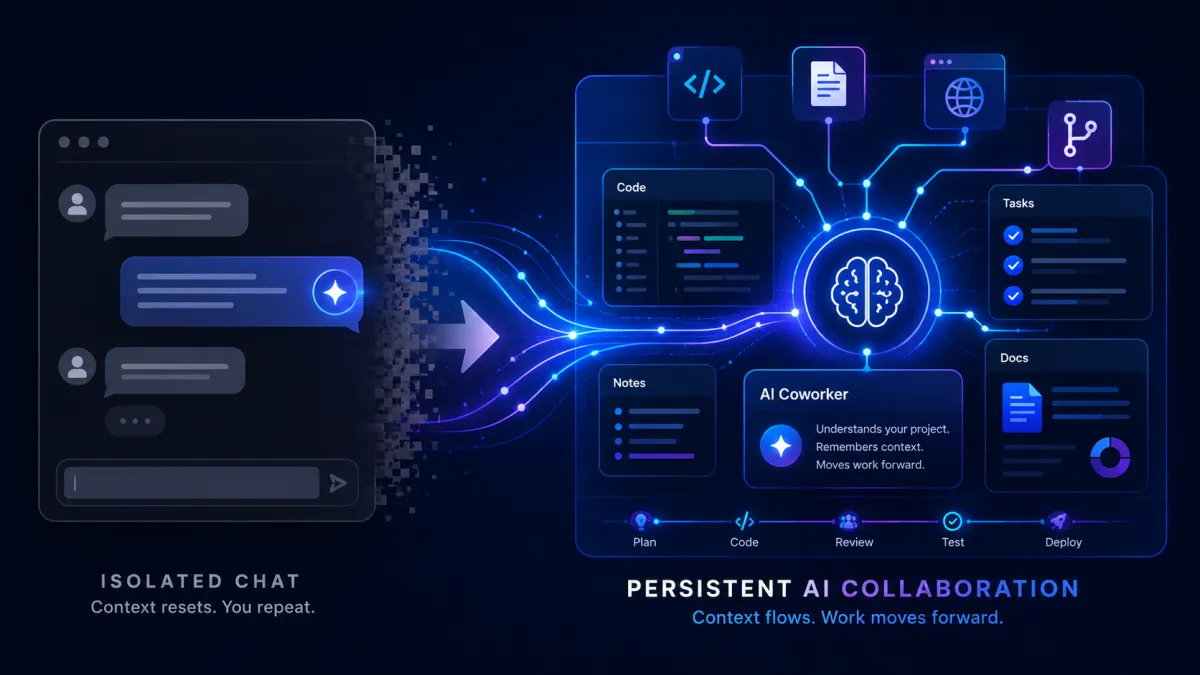
The chatbot was never meant to be the final interface for AI.
It was a practical starting point. Open a chat, describe a problem, receive an answer, repeat. That interaction model made large language models accessible to millions of users, but it also introduced a recurring inefficiency: every new conversation resets the context.
Developers paste source code into prompts. Writers summarize projects they've already explained. Analysts repeatedly upload the same documents. Valuable context disappears the moment the chat ends.
This isn't simply an inconvenience. It's becoming the biggest obstacle to productive AI adoption.
Recent products—including Anthropic's Claude Cowork—suggest the industry is moving toward a different model. Rather than treating AI as a tool users open when they need help, companies are embedding AI directly into the work itself. The interface is shifting from isolated conversations to persistent collaboration.
The Chat Window Solved Accessibility, Not Productivity
The chat interface succeeded because it required almost no learning curve. If someone could use a messaging app, they could use an AI assistant.
That simplicity accelerated adoption, but it also exposed several limitations.
Every new session requires users to rebuild context by explaining:
- the project
- the objective
- previous decisions
- coding standards
- business requirements
- preferred writing style
For small tasks, this overhead is negligible.
For long-running engineering, research, or content workflows, it becomes repetitive and inefficient.
The result is an interaction pattern where humans spend significant time managing context instead of solving problems.
The issue isn't model capability. It's interface design.
Persistent AI Changes the Unit of Work
Traditional chatbots revolve around individual prompts.
Persistent AI systems revolve around ongoing work.
Instead of responding to isolated requests, they remain connected to repositories, documents, browser sessions, or collaborative workspaces. That continuity allows them to accumulate context over time rather than reconstructing it with every interaction.
For software teams, this could mean an assistant that understands a repository's architecture across multiple coding sessions. For content teams, it might involve AI that remembers editorial guidelines, publication history, and audience preferences without requiring repeated instructions.
The shift is subtle but important.
The conversation becomes secondary. The workflow becomes primary.
This is the same transition that transformed cloud software from standalone applications into collaborative platforms. AI appears to be following a similar trajectory.
The Industry Is Converging on Continuous Collaboration
Anthropic isn't alone in exploring persistent AI experiences.
Across the industry, development environments, productivity platforms, browsers, and enterprise software are integrating AI directly into existing workflows instead of treating it as a separate destination.
Developers increasingly work with AI inside their IDEs rather than switching to external chat interfaces. Productivity suites surface AI while documents are being written. Browser-based assistants operate alongside web applications instead of requiring users to copy information into a separate window.
These implementations differ, but they share a common design philosophy: reduce context switching.
The long-term competition may no longer center on who builds the most capable language model. It may center on who builds the interface that minimizes friction between human intent and AI assistance.
Persistent Context Creates New Engineering Challenges
Keeping AI continuously connected to work introduces problems that chatbots largely avoided.
Persistent systems need to manage:
- evolving project context
- permission boundaries
- memory retention
- sensitive information
- collaboration across multiple users
- changing repositories and documents
They also raise practical questions about governance.
How long should AI remember previous interactions?
Which information should remain private?
How should organizations audit decisions influenced by persistent AI?
These aren't merely technical issues. They're operational concerns that affect trust, compliance, and enterprise adoption.
As AI becomes more deeply integrated into everyday work, context management may become as important as model performance.
The Next Competitive Advantage Is Workflow Awareness
Early AI competition focused on benchmark scores and reasoning ability.
The next phase may be determined by workflow awareness.
Organizations don't simply want smarter models. They want systems that understand ongoing work, adapt to changing objectives, and participate in established processes without requiring constant reorientation.
That doesn't mean the chat interface will disappear. Quick questions, brainstorming sessions, and ad hoc research will continue to benefit from conversational interactions.
But for sustained knowledge work, persistent collaboration is likely to become the default.
The companies that succeed won't necessarily be those with the most advanced models. They'll be the ones that make AI feel like a natural part of the workflow rather than another application employees have to open.
Final Recommendation
The emergence of products like Claude Cowork signals a broader evolution in how AI fits into professional work. The real innovation isn't a new chat feature or interface—it's the recognition that productivity depends as much on continuity as it does on intelligence.
For engineering teams, content creators, and knowledge workers, the most valuable AI systems will increasingly be those that stay connected to projects instead of waiting for prompts. Persistent collaboration reduces repetitive context-building, keeps institutional knowledge closer to the work, and allows AI to participate more naturally in long-running tasks.
The next interface for AI isn't another chatbot. It's a workspace where conversations become just one part of a continuous, context-aware collaboration.