
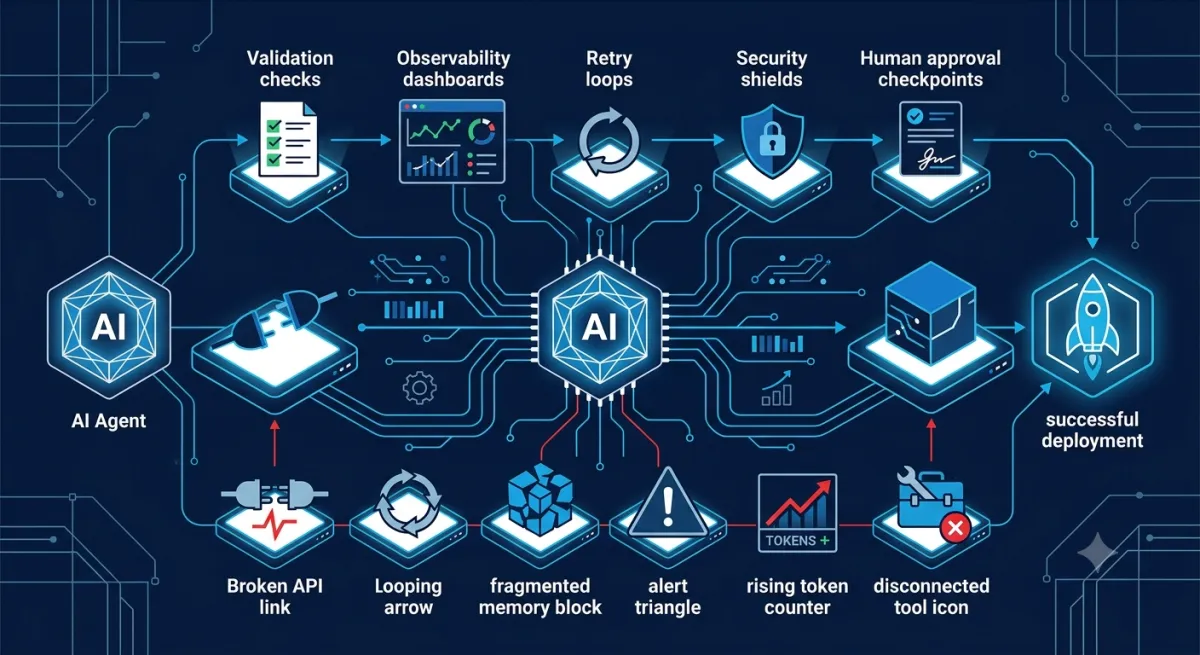
Why Most AI Agents Fail in Production (And How Engineering Teams Prevent It)
Building an AI agent is surprisingly easy.
Operating one is not.
Modern frameworks can connect language models to tools, memory, APIs, and workflows with only a few hundred lines of code. Within hours, an agent can search the web, query databases, summarize documents, or execute multi-step tasks.
Yet many of these same agents fail when exposed to real production environments.
The reason isn't that large language models are incapable.
It's that production systems must operate under constraints that demos rarely simulate: unreliable networks, incomplete data, changing APIs, security requirements, latency budgets, and unpredictable user behavior.
The biggest challenge in enterprise AI is no longer building an agent. It's keeping one reliable.
AI Agents Fail Because They're Systems, Not Features
Many organizations still treat AI agents like software features.
They're closer to distributed systems.
A production agent often depends on:
- one or more language models
- external APIs
- retrieval systems
- vector databases
- authentication services
- workflow engines
- memory stores
- observability platforms
- evaluation pipelines
Every dependency introduces another potential point of failure.
A successful architecture assumes these failures will happen and is designed to recover gracefully.
Failure Mode #1: Tool Calls Break
Language models don't perform work themselves.
They ask tools to perform work.
If an API changes, credentials expire, rate limits are exceeded, or a third-party service becomes unavailable, the agent may produce incomplete or misleading results.
Engineering teams reduce this risk by implementing:
- retry policies
- timeout handling
- circuit breakers
- fallback tools
- structured error responses
The objective isn't eliminating failures.
It's ensuring failures remain predictable.
Failure Mode #2: Planning Loops Never End
Many autonomous agents repeatedly generate new plans without making meaningful progress.
Symptoms include:
- repeated reasoning
- duplicate actions
- recursive tool calls
- escalating token costs
This often happens when success conditions are poorly defined.
Production systems introduce execution limits such as:
- maximum planning depth
- iteration caps
- budget limits
- confidence thresholds
- human approval checkpoints
Autonomy without boundaries quickly becomes expensive.
Failure Mode #3: Memory Becomes a Liability
Memory improves continuity.
Poor memory degrades performance.
Common problems include:
- storing irrelevant information
- retrieving outdated context
- conflicting historical facts
- oversized context windows
- privacy risks
Rather than remembering everything, effective systems prioritize relevance.
Many organizations implement memory expiration policies, quality scoring, and selective retrieval to ensure historical information remains useful.
Good memory requires active management.
Failure Mode #4: Hallucinations Trigger Real Actions
A chatbot generating an incorrect answer is one problem.
An autonomous agent acting on incorrect information is another.
Examples include:
- creating incorrect tickets
- updating the wrong customer record
- executing invalid code
- sending inaccurate emails
- triggering inappropriate workflows
Engineering teams reduce this risk through verification layers.
High-impact actions often require:
- schema validation
- secondary model verification
- business rule checks
- deterministic tool outputs
- human approval for sensitive operations
Reasoning should never be the only safeguard.
Failure Mode #5: Observability Is Missing
Traditional software teams monitor:
- latency
- availability
- error rates
AI systems require additional visibility.
Questions include:
- Which prompt generated this response?
- Which model version handled the request?
- Which tools were called?
- How many retries occurred?
- How much did the interaction cost?
- Where did reasoning fail?
Without observability, debugging becomes guesswork.
Production AI should generate telemetry as comprehensive as any cloud service.
Failure Mode #6: Cost Grows Faster Than Usage
A successful AI agent often becomes more expensive over time.
Longer conversations.
More tool calls.
Additional reasoning steps.
Larger context windows.
Premium models.
Costs increase gradually until they become an operational concern.
Engineering teams manage this through:
- model routing
- token budgets
- workload scheduling
- response caching
- cost monitoring
- request prioritization
Optimizing cost isn't about reducing quality.
It's about matching computational resources to business value.
How Engineering Teams Build Reliable AI Agents
Reliable agents rarely rely on a single innovation.
They combine multiple operational practices.
Evaluate Continuously
Every deployment should be tested against representative tasks before reaching production.
Automated evaluations detect regressions that manual testing often misses.
Observe Everything
Logs should capture prompts, model versions, tool interactions, latency, token usage, and outcomes.
Complete visibility shortens debugging cycles.
Design for Failure
Assume providers become unavailable.
Assume tools return errors.
Assume retrieval occasionally fails.
Architectures that anticipate failure recover more gracefully than those that expect perfect execution.
Keep Humans in the Loop
Not every decision should be automated.
Financial approvals, legal actions, customer communications, and production deployments often benefit from human review.
Automation works best when paired with appropriate oversight.
Production Success Is an Operational Discipline
The strongest AI organizations increasingly resemble mature software engineering teams.
They don't simply build better prompts.
They invest in:
- evaluation pipelines
- observability
- governance
- security
- workload routing
- prompt versioning
- incident response
- deployment automation
These practices transform AI from an experimental capability into dependable infrastructure.
The difference between an impressive demo and a reliable production agent is rarely the language model itself.
It's everything surrounding it.
Final Thoughts
AI agents fail in production for the same reason many distributed systems fail: complexity grows faster than architecture.
Tool failures, planning loops, hallucinations, memory issues, missing observability, and uncontrolled costs are not isolated bugs. They're predictable operational challenges that emerge as AI systems scale.
Engineering teams that acknowledge these realities early can design agents that remain reliable under real-world conditions. Rather than treating AI as a standalone capability, they build resilient systems with clear boundaries, measurable performance, and well-defined recovery strategies.
The future of autonomous AI won't belong to the agents that perform best in demonstrations. It will belong to the ones that continue working when everything around them doesn't.