

Xata AI
Use Xata AI as the anchor for a real shortlist.
Instead of returning to a broad directory, jump straight into the strongest adjacent matchups for pricing, workflow fit, and differentiation.
Overview
Overview
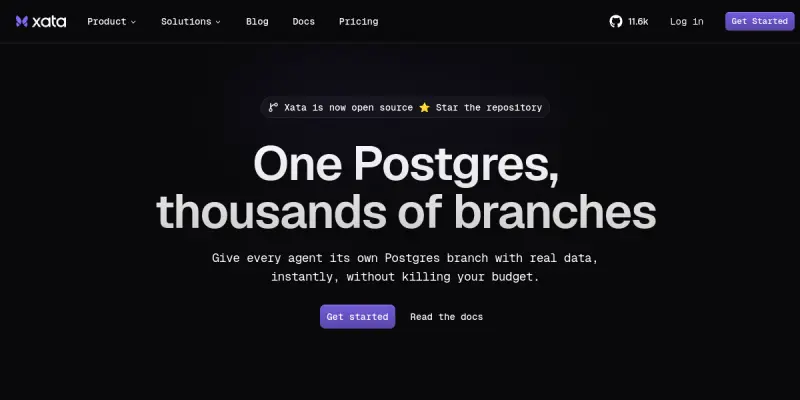
Xata AI is a database platform built around Postgres that introduces instant, copy-on-write branching for your database. It allows developers to create isolated, writable copies of their production database in seconds — including fully anonymized data — without the cost or complexity of traditional staging replicas. This means teams can run migrations, test queries, and develop features against realistic data sets without risking performance or security in production.
The platform is designed to integrate seamlessly into existing development workflows, providing a branch-per-feature model that mirrors Git workflows. By eliminating the need for full staging environments, Xata AI reduces infrastructure overhead and accelerates the feedback loop for database-related changes.
Key Features
- Instant Database Branching: Create a full copy of your Postgres database in seconds using copy-on-write technology. Branches are writable and isolated from each other and from production.
- Anonymized Production Data: Automatically anonymize sensitive data when branching from production, ensuring compliance with data privacy regulations while providing realistic test data.
- Branch Snapshots: Capture point-in-time snapshots of any branch, enabling rollback and reproducibility during development.
- Merge & Deploy: Merge branches back to production with confidence, with built-in conflict detection and schema diff tooling.
- Integration with Git Workflows: Trigger database branching automatically from pull requests via CLI or API, aligning database changes with code changes.
- Web UI & CLI: Manage branches, view data, and run queries from a web interface or a command-line tool.
- Read Replicas for Production: Scale read-heavy workloads with independent read replicas, ensuring the primary database remains responsive.
Use Cases
Feature Development and Testing
When a developer starts work on a new feature, they can spawn a database branch from production in seconds. The branch contains anonymized data that mirrors real-world conditions, so they can test migrations and queries accurately. Once the feature is ready, it can be merged back with a single command.
Database Migration Testing
Schema migrations are notoriously risky. With Xata AI, teams can test complex ALTER TABLE operations on a branch before applying them to production. If something goes wrong, simply drop the branch and start again — no downtime, no rollback scripts.
Staging Environment Replacement
Traditional staging environments require running a full copy of the production database on dedicated hardware, which is slow and expensive. Xata AI’s branching model provides a lightweight alternative: each feature branch acts as its own staging environment, sharing storage through copy-on-write.
Data Science & Analytics
Data scientists can access anonymized production data in a dedicated branch without interfering with live traffic. They can run heavy analytical queries, build models, and generate reports using real data patterns.
Pricing & Plans
Xata AI offers a Freemium model with a free tier that includes a limited number of branches, storage, and compute. Paid plans scale with the number of branches, storage capacity, and additional features such as team collaboration and priority support. Enterprise pricing is available on request and includes dedicated infrastructure, custom data residency, and advanced security controls. Specific price points are not publicly disclosed.
Integrations & Compatibility
Xata AI integrates with popular developer tools and platforms including GitHub, GitLab, and Bitbucket for seamless CI/CD pipelines. It provides a REST API and a CLI for automating database operations. The platform supports standard Postgres drivers and ORMs such as Prisma, TypeORM, and Sequelize, making it easy to adopt without changing existing code.
Who Is It For?
Xata AI is primarily aimed at development teams and DevOps engineers who work with Postgres databases. It is especially valuable for teams practicing trunk-based development, feature flags, or continuous deployment, where quick, isolated database environments are essential. It also suits organizations that need to comply with data privacy regulations while providing realistic test data to developers.
Limitations
- Postgres Only: Xata AI is built exclusively for Postgres databases. Teams using MySQL, SQLite, or other database systems will not benefit directly.
- Data Anonymization Complexity: While Xata AI can anonymize columns, configuring fine-grained anonymization rules for complex schemas may require manual setup.
- Dependency on Xata AI Infrastructure: Because branches are hosted on Xata’s platform, moving away from it would require migrating the database and losing the branching capability.
Final Verdict
Xata AI introduces a powerful branching model that addresses a real pain point for Postgres users — the cost and friction of creating realistic staging environments. The instant branching with anonymized data is a standout feature, and the integration with Git workflows makes it a natural fit for modern development pipelines.
While it is limited to Postgres and requires trust in a third-party infrastructure provider, the freemium model allows teams to try it out with minimal commitment. For teams that rely heavily on Postgres and need to iterate quickly on database changes, Xata AI is a compelling tool worth evaluating.
Tool Facts
Screenshots & Interface
Pros
- ✓ Creates isolated Postgres database branches in seconds, eliminating the wait for staging replicas.
- ✓ Supports anonymized production data out of the box, helping teams comply with data privacy regulations.
- ✓ Integrates with Git workflows and CI/CD pipelines for automated database branching per pull request.
- ✓ Offers a free tier that provides a realistic starting point for small teams and individual developers.
- ✓ Includes a web UI and CLI, catering to both visual and command-line oriented developers.
Cons
- × Only supports Postgres, leaving teams using other databases without direct benefit.
- × Configuring custom anonymization rules for complex schemas can require extra manual effort.
- × Being a hosted platform, migrating away from Xata requires a full database migration and loss of branching features.
- × The free tier has a limited number of branches and storage, which may not scale for larger teams.
How to Use Xata AI in Your Workflow
Integrating Xata AI into your professional toolkit enhances efficiency by automating manual steps. By configuring it to suit your specific project requirements, you can optimize output quality and reduce project cycle times. Standard workflows involve testing the tool on simple tasks before scaling its use to complex operations.
Frequently Asked Questions
What is Xata AI used for?
Xata AI provides instant database branching for Postgres, letting you create isolated, copy-on-write branches with anonymized production data. It is designed for developers and DevOps teams that want to accelerate their development workflow without the cost and overhead of traditional staging replicas. Its key differentiator is the ability to spawn full database environments in seconds, directly from production data.
What is the pricing model for Xata AI?
Xata AI uses a Freemium pricing model.
What are the main advantages of Xata AI?
The key benefits of Xata AI include: Creates isolated Postgres database branches in seconds, eliminating the wait for staging replicas., Supports anonymized production data out of the box, helping teams comply with data privacy regulations., Integrates with Git workflows and CI/CD pipelines for automated database branching per pull request., Offers a free tier that provides a realistic starting point for small teams and individual developers., Includes a web UI and CLI, catering to both visual and command-line oriented developers..
What are the main limitations of Xata AI?
Some limitations or cons of Xata AI are: Only supports Postgres, leaving teams using other databases without direct benefit., Configuring custom anonymization rules for complex schemas can require extra manual effort., Being a hosted platform, migrating away from Xata requires a full database migration and loss of branching features., The free tier has a limited number of branches and storage, which may not scale for larger teams..
Alternative AI Tools

Codacy AI
Codacy AI automates code quality and security checks for development teams, offering AI-powered suggestions to streamline engineering workflows.

Windsurf
Windsurf is an AI-native integrated development environment (IDE) designed for developers and enterprises. It integrates advanced code completion and generation capabilities directly into the editor workflow. The platform focuses on keeping developers in the flow state through intelligent code assistance.

Dgraph AI
Dgraph is a graph database designed for high-scale, real-time queries. It targets developers and data engineers building applications that require efficient graph traversal and low-latency data retrieval. Its key differentiator is being fully open-source while handling terabyte-scale workloads.
Rating Details
Based on 0 ratings
Quick Comparisons
Related Tools
More AI tools from the same workflow, industry, or category.
AICode
AICode is a spec-driven AI coding copilot for developers using Visual Studio Code. It enforces a disciplined workflow to prevent AI-generated technical debt and ensures maintainable code. Its key differentiator is forcing line-by-line human review before changes are applied.
Opik
Opik is an open-source platform for LLM observability and evaluation. It helps developers trace, test, and monitor AI applications and autonomous agents throughout development and production.
PlanetScale AI
PlanetScale provides serverless cloud hosting for Vitess and PostgreSQL databases. It targets developers and engineering teams requiring high-performance, scalable database infrastructure. The platform enables instant scaling and branching workflows.
CodeReview AI
CodeReview AI is a tool that uses artificial intelligence to analyze code and suggest improvements. It helps developers identify bugs, security issues, and style inconsistencies automatically. The tool integrates with popular version control systems to fit into existing workflows.
Reviews
No reviews submitted yet. Be the first to share your experience.
Write a Review
Share Your Experience
Join the community to write reviews, submit ratings, and bookmark your favorite AI tools.