
AI Memory Explained: Why Chat History Isn't Enough for Intelligent Agents
Memory is becoming the next competitive advantage in AI.
Over the past few years, the conversation has focused on larger models, longer context windows, and better reasoning. Those advances matter, but they don't solve a fundamental limitation: every new interaction often starts from scratch.
An AI assistant that forgets your preferences, your previous projects, and your long-term goals isn't truly intelligent—it simply has a large context window.
The next generation of AI systems is addressing this limitation through persistent memory. Rather than treating every request as an isolated prompt, they accumulate knowledge, retrieve relevant context, and adapt over time.
The result isn't just a better chatbot. It's a more capable software system.
Context Windows Are Not Memory
One of the most common misconceptions is that a larger context window means an AI has memory.
It doesn't.
A context window is temporary working space. It holds information for the duration of a request or conversation, but once that interaction ends, the information is typically discarded unless it is stored elsewhere.
Think of it like a whiteboard in a meeting room.
You can write a lot on it, but when the meeting ends, everything is erased.
Memory begins only when information is intentionally preserved and made available for future interactions.
Understanding this distinction helps explain why many AI applications still feel repetitive despite increasingly capable models.
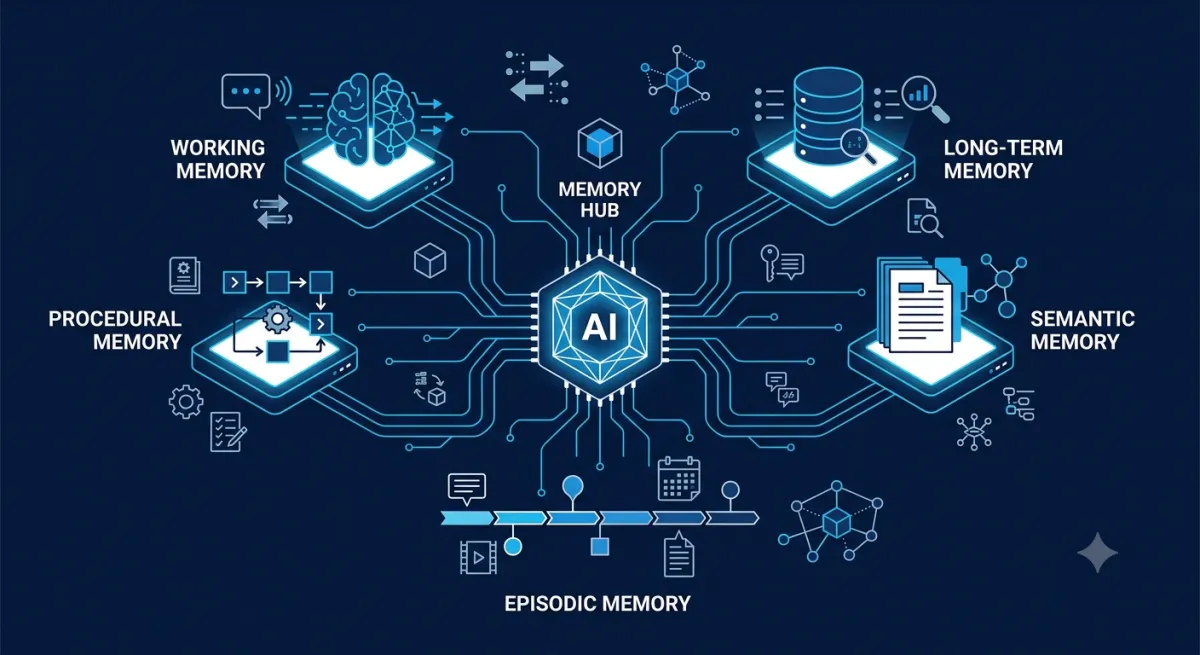
The Five Layers of AI Memory
Modern AI systems combine several forms of memory, each solving a different problem.
1. Working Memory
Working memory is the information available during the current interaction.
Examples include:
- the active conversation
- uploaded documents
- current instructions
- temporary calculations
This layer changes continuously and disappears unless saved elsewhere.
Its primary role is enabling coherent reasoning within a single task.
2. Long-Term Memory
Long-term memory stores information across multiple sessions.
Examples include:
- user preferences
- recurring tasks
- project history
- saved goals
- frequently used workflows
Instead of asking users to repeat the same information every time, AI systems can retrieve previously stored knowledge when it becomes relevant.
3. Semantic Memory
Semantic memory contains factual knowledge rather than personal experiences.
For example:
- product documentation
- company policies
- technical manuals
- research papers
- internal knowledge bases
This information is commonly retrieved using Retrieval-Augmented Generation (RAG), allowing models to access current information without retraining.
4. Episodic Memory
Episodic memory captures events.
Rather than storing isolated facts, it remembers sequences such as:
- previous troubleshooting sessions
- customer interactions
- completed workflows
- historical decisions
This allows AI systems to understand not only what happened but when and why.
5. Procedural Memory
Procedural memory represents learned processes.
Examples include:
- preferred coding workflows
- recurring automation steps
- approval processes
- standard operating procedures
Instead of repeatedly instructing an AI how to perform a task, procedural memory allows those patterns to become reusable operational knowledge.
How AI Memory Works in Production
Production AI systems rarely rely on a single memory mechanism.
Instead, they orchestrate multiple components.
A typical workflow might look like this:
- Receive a user request.
- Search long-term memory for relevant preferences.
- Retrieve supporting documents from a knowledge base.
- Load recent conversation history.
- Apply organizational policies.
- Generate a response.
- Decide whether any new information should be stored.
The model itself doesn't remember everything.
It accesses different memory systems depending on the task.
This architecture keeps responses both relevant and efficient.
Why Persistent Memory Matters
Persistent memory transforms AI from a reactive tool into a continuously improving assistant.
Consider the difference between two coding assistants.
The first forgets every project after each session.
The second remembers:
- your preferred programming languages
- coding conventions
- project architecture
- previous bug fixes
- deployment environment
Both may use the same language model.
The experience is dramatically different because one has memory beyond the current conversation.
The same principle applies to customer support, sales assistants, healthcare documentation, education, and enterprise knowledge management.
Memory enables continuity.
Designing AI Memory Responsibly
Remembering more information isn't always better.
Engineering teams must balance personalization with governance.
Key considerations include:
Relevance
Not every interaction deserves permanent storage.
Memory should prioritize information that improves future performance.
Privacy
Users should understand what information is retained and have meaningful control over it.
Retention Policies
Some data should expire automatically.
Outdated preferences or obsolete project information can reduce response quality.
Security
Persistent memory often contains sensitive information and should follow the same security standards as other enterprise data.
A well-designed memory system remembers what is useful while forgetting what is unnecessary.
The Future of AI Is Stateful
For decades, software has relied on databases to preserve information.
AI is evolving in the same direction.
Instead of stateless prompt-response systems, future AI applications will increasingly maintain rich, structured memory that spans conversations, workflows, and even years of interaction.
This shift has architectural implications.
Memory becomes another infrastructure layer alongside:
- language models
- AI gateways
- evaluation systems
- observability platforms
- orchestration frameworks
Organizations that treat memory as a core platform capability—not simply as chat history—will be able to build AI systems that become more valuable with continued use rather than starting over each time.
Final Thoughts
The phrase AI memory often evokes the idea of a chatbot remembering previous conversations. In reality, production AI relies on a collection of specialized memory systems that work together to provide context, continuity, and personalization.
As AI applications move beyond isolated prompts toward long-running workflows and autonomous agents, memory will become one of the defining architectural components of intelligent software. Models may generate responses, but memory provides the context that makes those responses consistently useful.
The future of AI isn't just about reasoning better. It's about remembering intelligently.