
An Open Model Is Not an Open AI System
Open model weights give developers more control, but production AI requires much more than a downloadable checkpoint. Beam illustrates a broader shift toward opening the infrastructure, tooling, and workflows surrounding AI models.
The weights are only the beginning
A team downloads an AI model, deploys it on its own infrastructure, connects it to a code repository, and builds an agent that can inspect files, execute commands, and modify software.
The team now controls where inference runs. It can experiment with different deployment configurations and, subject to the license, customize the model for its needs.
But several questions remain unanswered.
Can the team reproduce the model's behavior? Can it inspect how the model was trained? Can it serve the model efficiently at production scale? Can it evaluate changes reliably, isolate code execution, and integrate the model into an existing agent framework?
These are different problems, and access to model weights does not automatically solve them.
This distinction is becoming more important as AI moves from conversational interfaces toward systems that perform multi-step tasks. Developers need control over not just the model, but also the infrastructure and software that make it useful.
In October 2026, Reflection AI provided a timely example with the public release of Beam, its first open-weight model, under the Apache 2.0 license. The company also announced an ecosystem of more than 40 partners and integrations, describing its broader ambition as an open operating system for agents.
The interesting part is not simply that another model has released its weights. It is the attempt to make the surrounding development and deployment stack more accessible.
Open weights, open source, and open systems are different things
The terms open-weight model, open-source AI, and open AI system are often used as though they mean the same thing. They describe different levels of access and control.
Open weights: access to the trained parameters
A model's weights are the learned numerical parameters that influence its outputs.
When those weights are publicly available under a suitable license, developers can download them, run the model on supported infrastructure, and potentially modify or fine-tune it.
This is a meaningful advantage over a model accessible only through a proprietary API. Developers can have greater control over deployment, data handling, inference configuration, and customization.
However, weights alone do not reveal the complete process that produced the model. They do not necessarily include the training dataset, full training code, or sufficient information to reproduce the training process.
Open-source AI: access to the means of understanding and modifying
The Open Source Initiative's Open Source AI Definition takes a broader approach. It identifies the components needed to exercise meaningful freedoms to use, study, modify, and share an AI system.
For machine-learning systems, this includes the model parameters, information about training data, and the code used to train and run the model, with the relevant components made available under appropriate terms.
This distinction matters because releasing parameters and releasing the means to understand how those parameters were produced are not equivalent.
A researcher can examine the behavior of an available model without necessarily being able to reconstruct its training process. A developer can fine-tune a model without knowing the full composition of its original training corpus.
An open-weight release can therefore be valuable without satisfying the broader definition of open-source AI.
An open AI system: control over the complete workflow
Even when a model and its development artifacts are open, the production system built around it may depend on additional components.
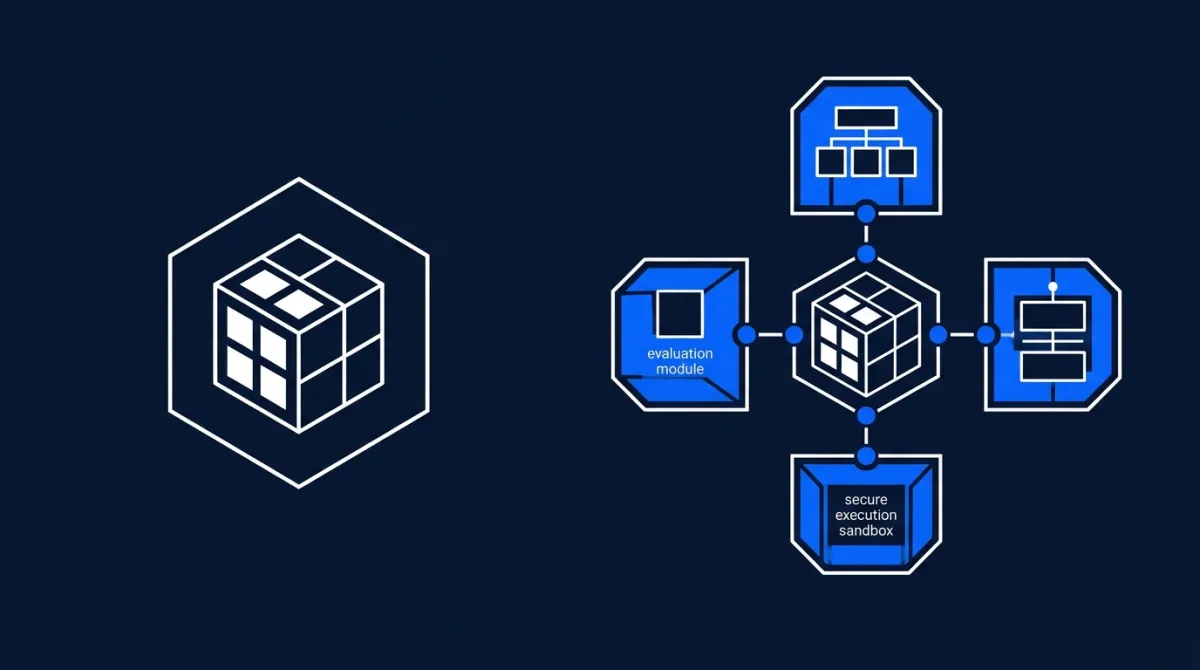
Consider a coding agent. Its behavior may depend on the model, inference engine, context-management strategy, tool integrations, execution sandbox, orchestration framework, and evaluation pipeline.
Opening the model does not automatically open every component in this chain.
Nor does it guarantee that those components can be replaced independently.
For engineering teams, this is often the practical question: can they understand, operate, modify, and migrate the system without being locked into a single provider's infrastructure or proprietary interfaces?
That is where the distinction between an open model and an open system becomes useful.
Beam: a case study in opening the surrounding stack
Reflection introduced Beam as a model focused on coding, reasoning, and long-horizon agentic workloads.
Its released architecture is a sparse mixture-of-experts model with 501 billion total parameters and 23 billion active parameters per token. The company released model weights under Apache 2.0 and published model documentation and a safety technical report.
The distinction between total and active parameters is relevant to inference efficiency. A sparse mixture-of-experts model activates only a subset of its experts for each token, rather than using every parameter for every token. This can reduce the computation required per token compared with a dense model of similar total size, although actual performance depends on architecture, hardware, routing, and serving configuration.
Reflection's wider release strategy extends beyond the checkpoint. Its launch announcement describes reference agent integrations, deployment containers, inference integrations, and customization pipelines, alongside an ecosystem of distribution and integration partners.
That approach addresses a practical limitation of open-weight releases: the distance between obtaining a model and building a reliable application with it.
A downloadable checkpoint is the starting point. Developers still need compatible inference software, hardware that can accommodate the model, deployment configurations, and tools for evaluating and adapting it.
The surrounding ecosystem determines how much of that work a team must build itself.
Beam is therefore an interesting example of an effort to open more of the application and deployment path. It should not, by itself, be taken as proof that every part of the underlying training process is fully reproducible or that every component in the ecosystem is interchangeable.
Those claims require separate evidence.
The hidden barrier is running the model
Access to weights can create a misleading impression of accessibility.
A large model may be legally available to download but operationally difficult to serve. Storage, memory, interconnect bandwidth, inference software, and concurrency all affect whether a deployment is practical.
Beam's 501-billion-parameter architecture illustrates this problem.
The model's active parameter count helps explain its computational characteristics, but it does not mean the entire model can fit into the memory needed for a small workstation. All required weights must be available across the serving infrastructure, subject to the implementation's architecture and execution strategy.
Different checkpoint formats also change deployment requirements. Lower-precision formats can reduce memory consumption, but the resulting performance and output quality need to be measured for the target workload.
A team evaluating an open-weight model should therefore separate three questions:
- Can we obtain and legally use it? This depends on the release, license, and intended use.
- Can we run it? This depends on hardware, memory, inference software, and deployment complexity.
- Can we operate it economically? This depends on throughput, latency, utilization, reliability, and the cost of maintaining the serving stack.
A model can satisfy the first condition while remaining difficult or uneconomical for a particular team to operate.
This is one reason infrastructure integrations matter. Support for existing serving engines and deployment platforms can reduce the amount of custom engineering required to move from model access to a working service.
But a deployment recipe is not a substitute for benchmarking. Teams still need to measure performance under their own context lengths, concurrency levels, and reliability requirements.
Inference efficiency is part of practical openness
Model capability is only one dimension of production value.
For an agent, the relevant cost is not necessarily the price of generating one token. It is the cost of completing a task successfully.
A coding agent might repeatedly inspect files, call tools, revise its plan, generate patches, and run tests. Its total resource consumption depends on how much reasoning it performs, how many tokens it generates, how efficiently its context is reused, and how often it needs to retry.
A model that performs well on a benchmark may still be expensive to operate if it requires long reasoning traces or generates many unsuccessful attempts.
Conversely, a model that reaches a comparable result with fewer inference operations may provide a meaningful economic advantage.
Reflection has emphasized reasoning efficiency as part of Beam's positioning. Google Cloud also published deployment work involving Beam and serving technologies including llm-d and NVIDIA Dynamo, reporting performance improvements for particular configurations.
Those results should be treated as configuration-specific evidence, not universal guarantees. Hardware, runtime, batching, context length, concurrency, and benchmark design can all change the outcome.
For developers, the practical lesson is to evaluate the complete serving path.
Measure time to first token, generation latency, throughput, peak memory, failure rate, and cost per successfully completed task. If the model is intended for agents, include tool execution, retries, and task completion in the evaluation.
An open system is more useful when its performance can be measured, tuned, and reproduced—not simply when its weights can be downloaded.
Why the agent layer matters
The next challenge is connecting the model to a working environment.
A model designed for coding and long-horizon reasoning needs a way to interact with files, execute commands, receive tool results, and continue its workflow. That requires more than the model's learned parameters.
A practical agent stack typically includes:
The model. Generates decisions, responses, and tool calls.
The inference runtime. Loads the model, manages memory, and serves requests.
The agent harness. Controls the interaction loop, including tool execution, context management, and stopping conditions.
The execution environment. Provides the tools and permissions available to the agent, ideally with isolation for risky operations.
The evaluation system. Measures task completion, correctness, regressions, and failure modes.
The deployment layer. Handles scaling, routing, monitoring, and reliability.
These components interact, but they solve different problems. A stronger model does not automatically provide a secure sandbox. A portable runtime does not guarantee that an agent's tools behave consistently. A successful benchmark does not prove that the deployed workflow is reliable.
Opening more of the stack gives developers more opportunities to inspect and replace these components. It also makes integration quality more important.
If the interfaces are tightly coupled or the documentation is incomplete, a nominally open ecosystem can still impose substantial migration costs.
The real test is replaceability
The most useful way to evaluate an open AI system is to ask what happens when one of its components needs to change.
Suppose a company deploys a coding agent using an open-weight model and a particular inference runtime. Six months later, the team wants to move to different hardware, adopt a newer model, or replace its agent framework.
A well-separated architecture should make that change manageable.
The model should be replaceable without rewriting unrelated business logic. The inference runtime should expose documented interfaces. Tool integrations should have clear contracts. Evaluation tests should reveal whether the new configuration changes task behavior. Security policies should remain intact when the execution environment changes.
In practice, some adaptation is inevitable. Models differ in tool-calling behavior, context limits, output formats, and reliability. Different runtimes support different optimization techniques. Some capabilities are provider-specific.
The objective is not to eliminate every compatibility issue. It is to make those differences visible and manageable rather than embedding them throughout the application.
Teams can test this directly:
- Deploy the model using one supported inference path.
- Run a representative set of evaluation tasks.
- Switch to another supported runtime or deployment configuration.
- Repeat the same tests under comparable conditions.
- Compare quality, latency, resource consumption, and operational complexity.
For agent systems, the evaluation should include successful task completion, not just similarity between generated responses.
This reveals whether the surrounding ecosystem provides real flexibility or merely a collection of nominally open components.
What developers should look for in an open model release
Before adopting an open-weight model for production, engineers should evaluate more than benchmark scores and licensing.
License and intended use. Read the actual license and confirm that it covers the planned deployment and redistribution model.
Model artifacts. Check which weights, checkpoint formats, model configurations, and documentation are available.
Training transparency. Determine what information is provided about training data, training methods, and the code used to produce the model. Do not infer reproducibility from the availability of weights.
Inference support. Verify compatibility with the serving engines and hardware the team can realistically operate.
Evaluation quality. Review benchmark methodology, test conditions, known limitations, and whether results have been independently reproduced.
Agent integration. Determine whether tool calling, context management, and the intended agent framework work reliably with the model.
Security and operations. Establish how tools are isolated, how credentials are handled, how failures are monitored, and how model updates are validated.
Exit costs. Estimate the work required to replace the model, runtime, or hosting provider later.
These checks turn the broad claim of openness into a concrete engineering assessment.
The future is not just open models
Open-weight models have already expanded what developers can do with AI. They offer a degree of control that API-only access cannot provide, and permissive licenses can make experimentation, customization, and deployment easier.
But model access is only one layer of the problem.
For teams building production agents, the surrounding infrastructure determines whether they can run a model efficiently, integrate it into existing workflows, evaluate changes, and migrate between components without excessive rework.
Reflection's Beam release highlights a broader direction: model developers are increasingly presenting their models alongside deployment paths, inference integrations, customization tools, and agent-building components.
That is a useful development, but the strongest claims of openness should still be evaluated component by component.
Can developers inspect what they are using? Can they understand its limitations? Can they reproduce the relevant results? Can they replace parts of the system? And can they operate the result securely and economically?
Those questions matter more than whether a release is marketed as open.
The goal is not merely to download a model. It is to build an AI system that developers can understand, control, and change.