
AI Middleware Explained: The Software Layer Nobody Talks About
Everyone talks about AI models.
Few people talk about everything that happens before a model receives a prompt.
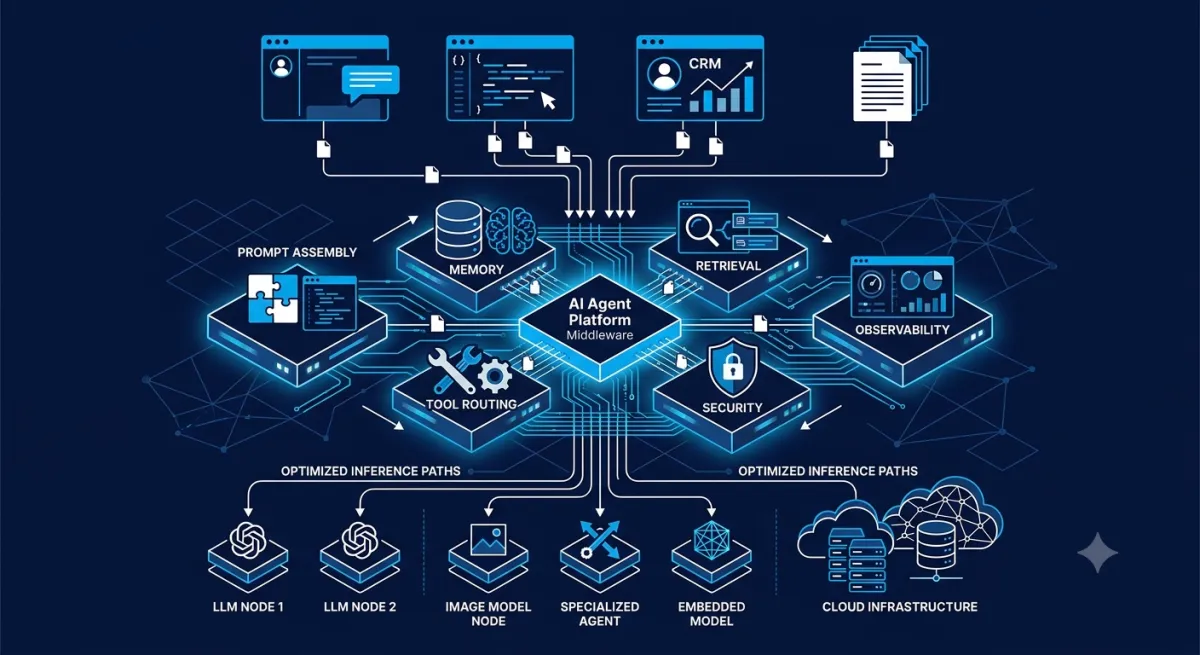
A production AI application doesn't simply send text to a language model and return the answer. Before the request reaches the model, it may pass through authentication, policy checks, prompt templates, retrieval systems, memory stores, tool routers, model selectors, and logging pipelines.
That invisible infrastructure is increasingly known as AI middleware.
It isn't a language model.
It isn't an AI agent.
It isn't an orchestration framework.
Instead, it's the software layer that connects every part of a modern AI application.
As enterprise AI grows more complex, middleware is becoming just as important as the models themselves.
The Hidden Complexity of Modern AI Applications
A simple chatbot prototype may consist of only three components:
- User interface
- Language model
- Response
Production systems rarely remain this simple.
A single enterprise request may involve:
- user authentication
- permission checks
- conversation memory
- document retrieval
- prompt assembly
- model routing
- tool execution
- response validation
- logging
- analytics
The language model performs only one step in a much larger workflow.
Without middleware, every application would need to implement these capabilities independently.
That quickly becomes impossible to maintain.
What Is AI Middleware?
AI middleware is the software layer that coordinates interactions between applications and AI services.
Rather than allowing applications to communicate directly with models, middleware provides shared services that simplify development and improve consistency.
Typical responsibilities include:
- request routing
- prompt construction
- memory management
- Retrieval-Augmented Generation (RAG)
- tool invocation
- authentication
- policy enforcement
- caching
- observability
- response validation
Applications interact with middleware.
Middleware interacts with the AI ecosystem.
This separation reduces duplication while making AI systems easier to manage.
AI Middleware vs. AI Gateway vs. AI Control Plane
These concepts are related but serve different purposes.
AI Gateway
An AI Gateway focuses on network traffic.
It typically handles:
- authentication
- rate limiting
- provider routing
- failover
- logging
Think of it as the front door to AI services.
AI Middleware
Middleware focuses on application logic.
It prepares requests before they reach the model and processes responses afterward.
Its role is coordination.
AI Control Plane
The control plane focuses on governance.
It manages:
- model approvals
- prompt versions
- deployment policies
- evaluations
- organizational standards
The gateway moves requests.
Middleware enriches requests.
The control plane defines the rules.
Together, these layers create a mature enterprise AI platform.
What AI Middleware Actually Does
Middleware combines multiple capabilities into a reusable platform.
Prompt Assembly
Instead of storing massive prompts inside application code, middleware dynamically combines:
- system instructions
- user input
- retrieved knowledge
- organizational policies
- memory
- formatting rules
This makes prompts easier to maintain and update.
Context Enrichment
Before a model responds, middleware retrieves the information most relevant to the request.
This may include:
- company documentation
- previous conversations
- customer profiles
- recent transactions
- project history
The model receives richer context without requiring larger prompts.
Tool Coordination
Rather than exposing every tool directly to the language model, middleware determines:
- which tools are available
- when they should be called
- how results should be formatted
- how failures should be handled
This improves reliability while reducing unnecessary tool usage.
Response Processing
After the model generates an answer, middleware can:
- validate structured output
- remove sensitive information
- enforce formatting
- trigger workflows
- store memory
- generate telemetry
The response users receive has often passed through multiple processing stages.
Why AI Middleware Matters
Middleware isn't simply another abstraction layer.
It delivers measurable operational benefits.
Faster Development
Teams build common capabilities once instead of recreating them for every AI application.
Better Consistency
Shared prompt templates, policies, and retrieval systems produce more predictable behavior across products.
Easier Maintenance
Updates to security rules, retrieval logic, or prompt structures occur in one location rather than dozens of applications.
Improved Reliability
Centralized retry logic, validation, and error handling reduce production failures.
Lower Costs
Middleware enables caching, intelligent routing, and context optimization, reducing unnecessary model usage.
Designing Effective AI Middleware
Good middleware balances flexibility with simplicity.
Engineering teams should evaluate:
Modularity
Can new capabilities be added without redesigning the entire platform?
Observability
Does every request generate meaningful telemetry?
Security
Can sensitive information be protected before reaching the model?
Performance
Does middleware improve developer productivity without introducing excessive latency?
Provider Independence
Can the organization adopt new AI models without rewriting application logic?
Strong middleware reduces dependence on individual vendors while increasing operational resilience.
Middleware Is Becoming the Foundation of Enterprise AI
Cloud computing evolved through infrastructure layers.
Databases became managed services.
API gateways standardized communication.
Service meshes coordinated microservices.
AI platforms are following the same trajectory.
Instead of treating every application as an isolated integration project, organizations are creating reusable AI platforms where middleware provides shared capabilities across the enterprise.
As this trend accelerates, developers will spend less time integrating models and more time building business functionality.
The AI stack is becoming layered.
Middleware is the layer that connects those layers together.
Final Thoughts
AI middleware rarely appears in product announcements or benchmark discussions, yet it is rapidly becoming one of the most important components of enterprise AI architecture.
By centralizing prompt management, context enrichment, tool coordination, security, and observability, middleware transforms scattered AI integrations into maintainable software platforms.
As organizations continue adopting multiple models, agents, and AI services, success will depend less on choosing the smartest model and more on designing the infrastructure that allows those models to work together effectively.
In that future, AI middleware won't be an optional architectural pattern. It will be the software foundation on which production AI systems are built.