
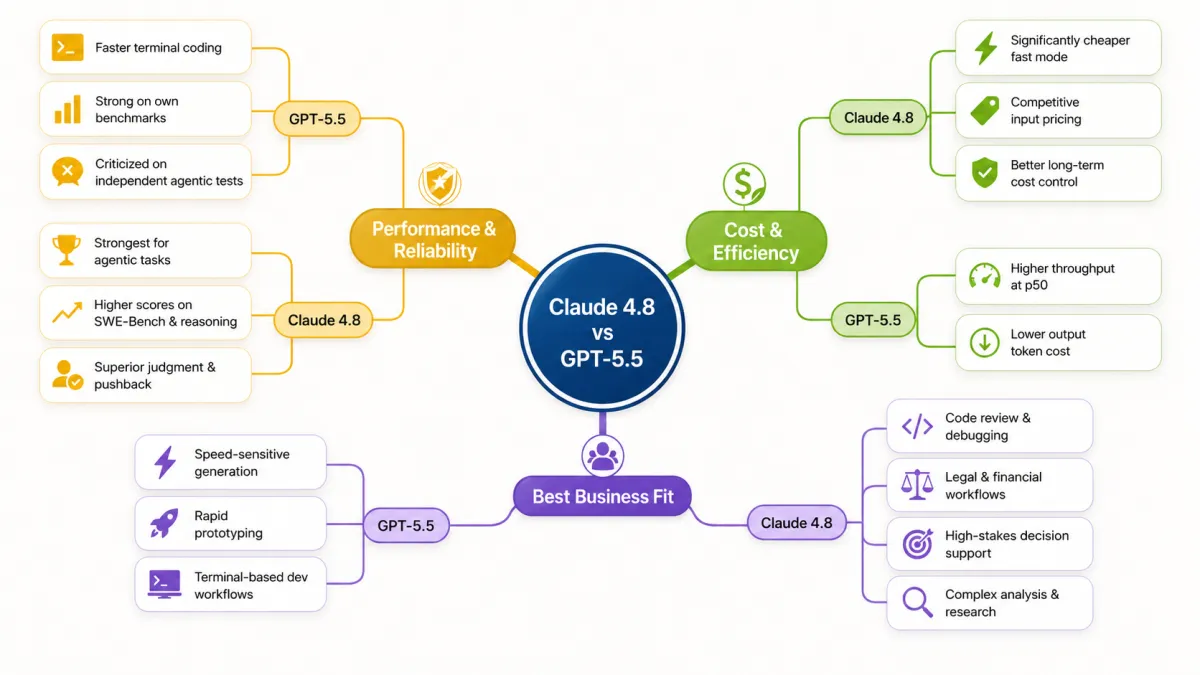
Based on the latest performance data, Claude Opus 4.8 generally offers superior reliability, judgment, and value for complex business tasks, while GPT-5.5 leads in specific coding speeds and terminal operations. The best choice for your business ultimately depends on your specific workflow priorities.
Here is a visual summary of the core comparison for quick decision-making:
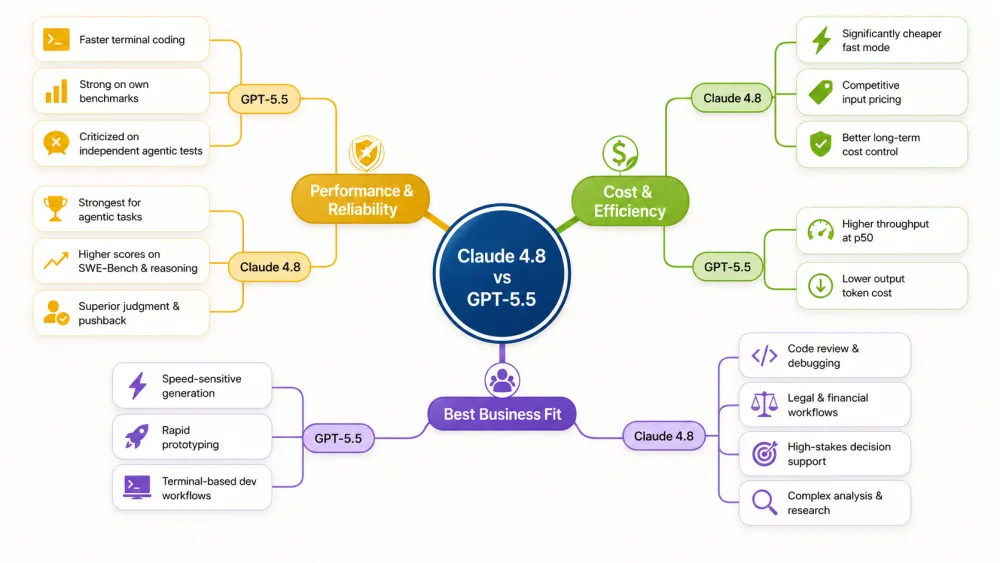
📊 Detailed Performance & Benchmark Analysis
Independent benchmarks and official reports reveal distinct strengths for each model. Understanding these nuances is critical before investing in an AI infrastructure for your team. The data below draws from multiple independent testing suites as well as vendor-supplied metrics, providing a comprehensive picture of where each model excels and where it falls short.
| Benchmark / Metric | Claude Opus 4.8 | GPT-5.5 | Analysis & Business Implication |
|---|---|---|---|
| SWE-Bench Pro (Real-world software engineering) | 69.2% | 58.6% | Claude demonstrates significantly better ability to understand and resolve complex, real-world coding issues. |
| Agentic Coding (LiveBench) | Not specified | 56.67 (vs. GPT-5.4's 70.00) | Claude is implicitly stronger here. GPT-5.5 showed a regression in independent agentic coding tests compared to its predecessor. |
| Terminal-Bench (OpenAI's own test) | 74.6% | 78.2% | GPT-5.5 excels at command-line interface tasks, beneficial for developers and system administrators. |
| Humanity's Last Exam (No Tools) | 49.8% | 41.4% | Claude shows stronger core reasoning and problem-solving without external tools. |
| Knowledge Work (GDPval) | 1890 | 1769 | Claude performs better on tasks simulating professional occupations (e.g., finance, legal, product management). |
| Agentic Financial Analysis | 53.9% | 51.8% | Claude has a slight edge in complex, multi-step financial reasoning. |
| Prosocial Traits & Safety | High (similar to Anthropic's most advanced model, Mythos) | Not specified in sources | Claude is designed to be more aligned with user autonomy and safety, crucial for enterprise trust. |
💰 Pricing & Cost-Efficiency Comparison
Cost is a critical business factor. The table below compares standard API pricing, but actual cost depends heavily on usage patterns and feature utilization. When evaluating these models, it is essential to consider not just the per-token price but also the total cost of ownership including integration effort, infrastructure requirements, and the potential cost savings from better model accuracy reducing rework cycles.

| Feature | Claude Opus 4.8 | GPT-5.5 | Gemini 3.1 Pro (For Context) |
|---|---|---|---|
| Input Cost | $5 / Million tokens | $5 / Million tokens | $2 / Million tokens |
| Output Cost | $25 / Million tokens | $30 / Million tokens | $12 / Million tokens |
| Cached Input Cost | $0.50 / Million tokens | $0.50 / Million tokens | $0.20 / Million tokens |
| Fast Mode Speed | Up to 2.5x faster | Not specified | Not specified |
| Fast Mode Cost | 3x cheaper than previous Claude fast modes | Not specified | Not specified |
| Max Output Tokens | 128K | 128K | 66K |
| Context Window | 1M tokens | 1.05M tokens | 1.05M tokens |
🔧 Key Technical Features & Developer Tools
Beyond raw performance, the developer experience and model features are pivotal for integration into business workflows. Each model offers unique capabilities that can significantly impact productivity and operational efficiency.
Claude Opus 4.8:
- Mid-Conversation System Messages: Allows updating instructions mid-turn without resetting the entire conversation, preserving cache and reducing cost in agentic loops.
- Effort Control: Users can specify the "effort" level (default is
high), balancing response depth, speed, and cost. This is a major tool for managing budget and latency. - Dynamic Workflows (Claude Code): Can orchestrate multiple sub-agents to tackle very large-scale problems, like codebase migrations.
- Stronger "Pushback": Testers highlight its improved judgment and tendency to proactively flag issues with inputs/outputs, making it a more reliable collaborator for critical tasks.
GPT-5.5:
- Reasoning & Tool Use: Marketed as stronger and more persistent, with more reliable tool use and the ability to stay on complex, multi-part tasks.
- Ecosystem Integration: Deeply integrated into OpenAI's evolving ecosystem, including Codex and ChatGPT.
- Higher Throughput: Shows higher throughput (tokens/second) at the 50th percentile in tests, which can translate to faster perceived response times for simple queries.
🎯 Strategic Recommendations: Which Model for Your Business?
Use this flowchart to guide your decision based on your primary business need. The right model depends on a careful evaluation of your team's workflows, the criticality of accuracy in your use case, and the total cost of ownership over time.
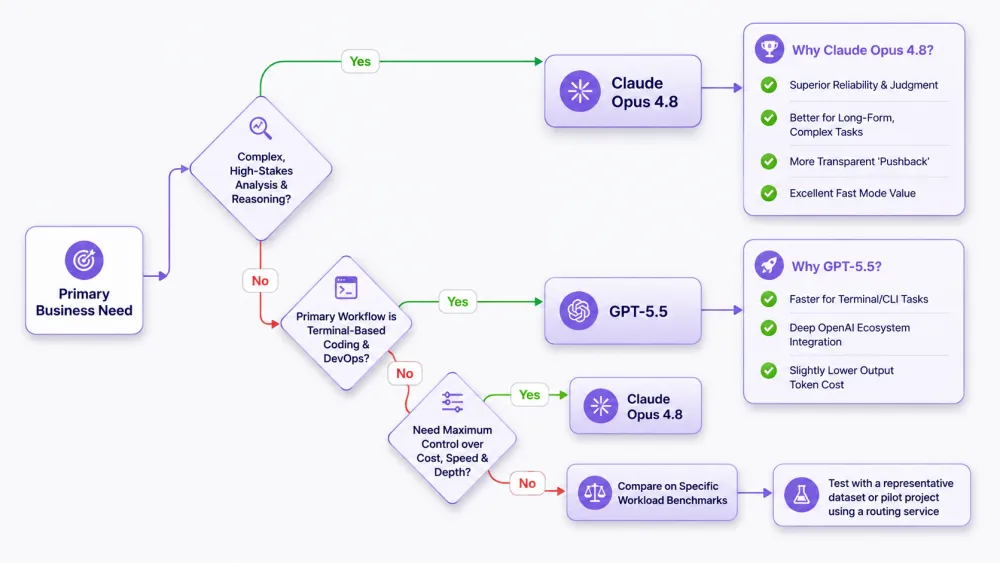
🟣 Choose Claude Opus 4.8 if your business prioritizes:
- Reliability & Quality in Complex Tasks: For legal analysis, financial modeling, deep research, and complex code debugging where errors are costly, Claude's higher benchmark scores and reported better judgment are invaluable.
- Autonomous Agent Workflows: For building AI agents that need to plan, use tools, reflect on their work, and maintain consistency over long horizons, Claude's performance on agentic benchmarks is stronger.
- Cost Control with Performance: The new fast mode offers a compelling blend of speed and reduced cost, and the effort control feature provides granular budget management.
- Safety & Alignment: If your business operates in regulated industries or values AI that acts more prosocially and transparently, Claude's design philosophy is a key advantage.
🟢 Choose GPT-5.5 if your business prioritizes:
- Speed in Specific Developer Workflows: If your team spends significant time in terminal environments and needs the fastest possible model for those specific tasks, GPT-5.5 has an edge.
- Deep OpenAI Integration: If you are already heavily invested in the ChatGPT, Codex, or broader OpenAI developer ecosystem, GPT-5.5 offers seamless integration and continuity.
- Output-Heavy Applications: For use cases that generate vast amounts of text where the slightly lower output token cost ($30 vs $25) compounds into significant savings.
⚖️ Final Verdict
For the majority of enterprise and business use cases—especially those involving complex reasoning, critical analysis, multi-step workflows, or autonomous agents—Claude Opus 4.8 is the recommended choice. Its combination of superior benchmark performance, enhanced judgment, innovative cost-control features, and strong safety profile makes it a more reliable and versatile partner for "real work."
GPT-5.5 remains a powerful model, particularly for developers entrenched in the OpenAI ecosystem who require top-tier terminal coding speeds. However, its mixed performance on independent benchmarks suggests it may not yet be the most robust choice for general business intelligence and complex task automation.
💡 Strategic Tip for Founders & Teams: For businesses with diverse AI needs, consider using a model routing service (like OpenRouter or a custom middleware). This allows you to dynamically send tasks to Claude Opus 4.8 for complex reasoning and GPT-5.5 for terminal-based coding, optimizing for both performance and cost without being locked into a single provider.
Published on TipJournal.com — Your premium directory and publishing platform for discovering the latest Artificial Intelligence tools, workflows, comparisons, and automation strategies.