
The AI Stack Explained: Every Layer From Infrastructure to Intelligent Applications
The biggest misconception about AI architecture is that the model is the application.
It isn't.
A language model generates text.
Everything else that makes an AI product reliable, scalable, secure, and useful happens around it.
When you ask an AI assistant to analyze a document, search company knowledge, call APIs, generate code, or automate workflows, the request passes through multiple architectural layers before reaching the model—and several more before the response reaches you.
As AI matures, understanding these layers is becoming as important as understanding the models themselves.
Welcome to the modern AI stack.
Why AI Is Becoming a Platform, Not a Product
Early AI applications were simple.
User → LLM → Response
Today's enterprise systems look very different.
User
 ↓
Application
 ↓
Agent / Workflow
 ↓
Memory + RAG + Tools
 ↓
Gateway + Middleware
 ↓
Model Router
 ↓
Foundation Models
 ↓
Cloud Infrastructure
Each layer exists because AI applications have become distributed software systems rather than isolated model integrations.
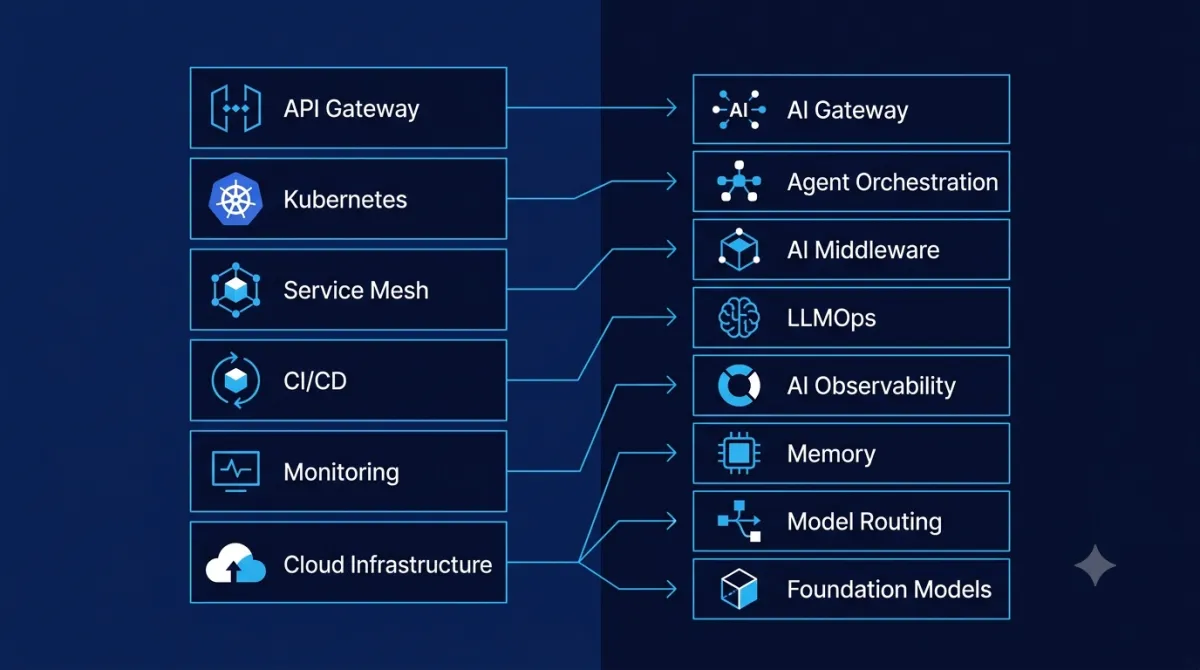
The AI stack is evolving much like the cloud stack evolved over the past decade.
Layer 1 — Infrastructure
Every AI application ultimately runs on infrastructure.
This includes:
- GPUs
- CPUs
- cloud platforms
- networking
- storage
- Kubernetes clusters
- inference servers
- serverless compute
Without reliable infrastructure, no AI model can serve production traffic.
The infrastructure layer determines:
- scalability
- availability
- throughput
- operational cost
This layer is largely invisible to users but fundamental to every AI system.
Layer 2 — Foundation Models
The next layer consists of the models themselves.
Examples include:
- frontier language models
- open-weight models
- vision models
- speech models
- embedding models
- reasoning models
Every model has different strengths.
Rather than choosing one model for everything, organizations increasingly treat models as interchangeable compute resources.
The application should depend on capabilities—not providers.
Layer 3 — Model Routing
As enterprises adopt multiple providers, selecting the right model becomes an architectural decision.
Model routers determine:
- which provider to use
- latency requirements
- cost targets
- workload complexity
- geographic availability
- fallback strategies
This layer transforms AI from a static API integration into a dynamic platform.
Layer 4 — AI Gateway
Before requests reach providers, many organizations place an AI Gateway in front of them.
Responsibilities include:
- authentication
- rate limiting
- provider abstraction
- logging
- retries
- failover
- API normalization
Applications integrate once.
The gateway handles provider complexity.
Layer 5 — AI Middleware
Middleware prepares requests for execution.
Typical capabilities include:
- prompt assembly
- context enrichment
- tool coordination
- memory retrieval
- output validation
- caching
- policy enforcement
Middleware reduces duplicated logic across applications.
It's the connective tissue of enterprise AI.
Layer 6 — Memory and Retrieval
Language models don't permanently remember organizational knowledge.
Instead, AI platforms retrieve relevant information at runtime.
This layer includes:
- vector databases
- Retrieval-Augmented Generation (RAG)
- user profiles
- conversation history
- semantic search
- long-term memory
Memory transforms isolated conversations into continuous experiences.
Layer 7 — Agents and Workflow Orchestration
This is where AI begins acting instead of merely responding.
Agents coordinate:
- planning
- tool execution
- decision making
- multi-step workflows
- automation
- collaboration between models
Rather than answering one question, agents complete objectives.
Layer 8 — Evaluation
Production AI must be measured continuously.
Evaluation systems determine:
- factual accuracy
- hallucination rates
- task success
- benchmark performance
- regression detection
- workflow quality
Without evaluation, improvements become assumptions rather than evidence.
Layer 9 — Observability
Traditional monitoring isn't enough.
AI observability tracks:
- prompt versions
- model selection
- token usage
- latency
- tool execution
- retrieval quality
- costs
- failures
Observability explains why an AI system behaved the way it did.
Layer 10 — Governance
Enterprise AI requires rules.
Governance layers define:
- approved models
- security policies
- compliance rules
- audit logs
- access permissions
- regional restrictions
- prompt policies
- human approval workflows
Governance enables organizations to scale AI safely.
Layer 11 — Applications
Everything above exists to support this final layer.
Applications include:
- coding assistants
- customer support
- enterprise search
- document analysis
- sales assistants
- legal review
- research agents
- autonomous workflows
Users interact with applications.
Applications rely on the entire stack beneath them.
How the Layers Work Together
Imagine a legal assistant reviewing a contract.
The request flows through the stack:
- A lawyer uploads a document.
- The application invokes an AI workflow.
- Middleware assembles prompts and retrieves relevant policies.
- Memory systems load previous contract templates.
- The gateway authenticates and routes the request.
- The model router selects a reasoning model.
- The model analyzes the contract.
- Evaluation validates the structured output.
- Observability records metrics.
- Governance ensures confidential data remains compliant.
- The application presents the final report.
The user experiences one seamless interaction.
Behind the scenes, nearly every layer participates.
Why Understanding the AI Stack Matters
Many architectural discussions focus exclusively on models.
That's becoming a mistake.
As models become increasingly capable and interchangeable, competitive advantage shifts toward the surrounding platform.
Organizations that invest in routing, memory, governance, evaluation, and observability often achieve greater reliability than those simply adopting the newest model.
The stack—not the model—is becoming the product.
The Future of AI Platforms
The AI stack is still evolving.
Emerging layers are already appearing, including:
- AI Control Planes
- Model Context Protocol (MCP)
- AI Identity
- Agent-to-Agent communication
- Workload schedulers
- Autonomous evaluation systems
Over time, these capabilities will integrate into unified AI platforms much as containers, service meshes, and API gateways became standard components of cloud-native architectures.
The AI stack will become more modular, more automated, and increasingly provider-agnostic.
Final Thoughts
Understanding the AI stack is no longer just for infrastructure engineers. It has become essential knowledge for anyone designing, deploying, or managing production AI systems.
Every layer—from infrastructure and foundation models to memory, gateways, evaluation, observability, and governance—plays a distinct role in delivering reliable AI experiences. As organizations move beyond experimentation, success will depend less on selecting the latest model and more on building a cohesive platform where every layer works together.
The future of enterprise AI won't be defined by a single breakthrough model. It will be defined by the quality of the stack that surrounds it.