
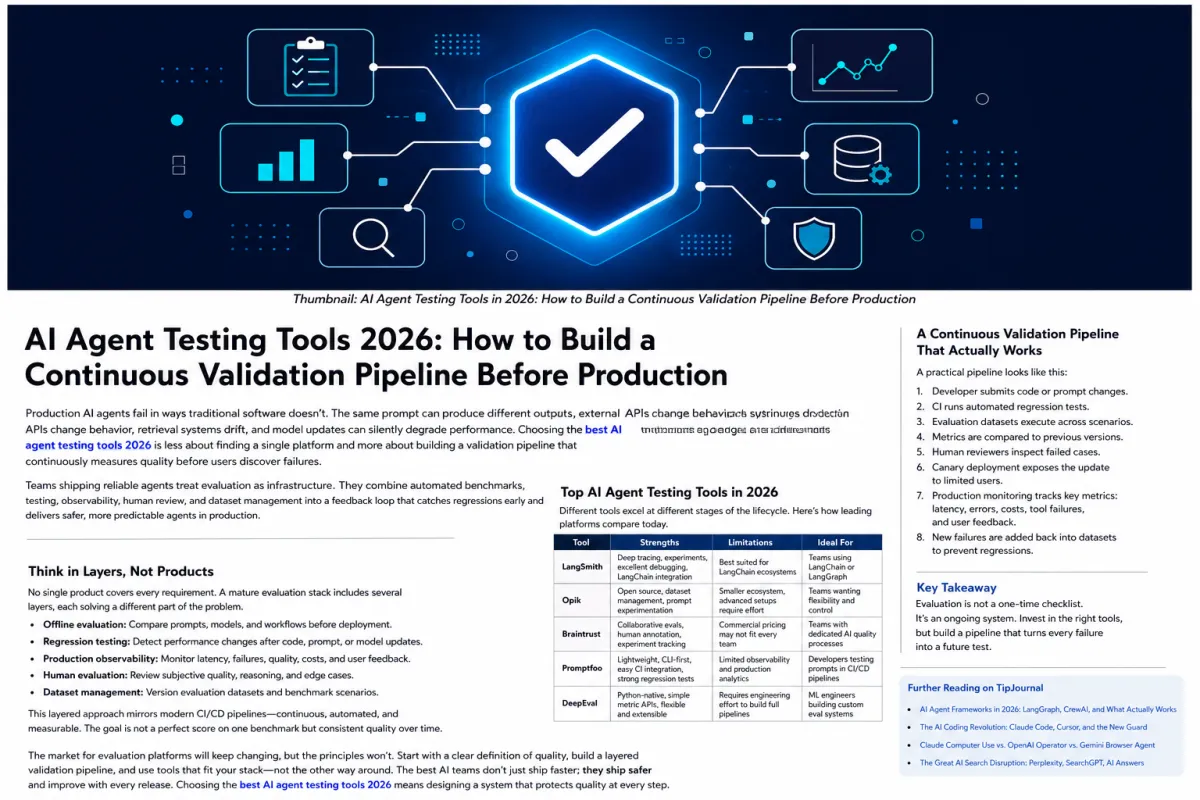
Production AI agents don't usually fail because the model is bad. They fail because no one noticed quality had slowly degraded. The teams shipping reliable AI systems in 2026 aren't relying on larger models—they're investing in continuous evaluation.
Production software has always been tested before release, but AI agents introduce a different class of engineering problems. Outputs are probabilistic, prompts evolve, retrieval systems drift, external APIs change behavior, and model providers frequently update their models. Traditional unit tests cannot detect many of these failures.
Selecting the best AI agent testing tools 2026 is therefore less about finding a single platform and more about building an evaluation pipeline that continuously measures quality before users experience regressions. The strongest engineering organizations increasingly treat AI evaluation as production infrastructure rather than an optional quality assurance step.
Why AI Agents Require a Different Testing Strategy
Traditional software answers one question:
Does the code behave correctly?
AI systems require several additional questions:
- Does the agent reason correctly?
- Did retrieval return the right information?
- Was the correct tool selected?
- Did the model hallucinate?
- Is the response still acceptable after a model update?
- Has prompt quality degraded over time?
Unlike deterministic software, AI systems can appear healthy while slowly becoming less reliable.
For example, changing a prompt may improve performance on one task while reducing performance on dozens of edge cases that no developer manually tested.
This is why evaluation has become a dedicated engineering discipline rather than simply another testing phase.
Best AI Agent Testing Tools 2026: Understanding the Evaluation Stack
One of the biggest misconceptions is that a single platform can handle every aspect of AI quality assurance.
In practice, mature teams build an evaluation stack composed of specialized layers.
| Layer | Purpose | Typical Output |
|---|---|---|
| Offline Evaluation | Compare prompts, workflows, and models | Quality scores |
| Regression Testing | Detect performance changes | Pass / Fail |
| Observability | Monitor production behavior | Dashboards & traces |
| Human Review | Evaluate reasoning quality | Feedback datasets |
| Dataset Management | Version benchmark cases | Reusable evaluations |
Each layer addresses different failure modes.
Offline testing identifies quality improvements before deployment.
Regression testing prevents accidental quality loss.
Production observability detects failures that only appear with real users.
Human evaluation captures subjective quality that automated metrics cannot measure.
Dataset management ensures improvements remain measurable over time.
Instead of searching for one perfect tool, engineering teams should focus on assembling these layers into a repeatable workflow.
Leading AI Agent Evaluation Platforms and Their Tradeoffs
The ecosystem has matured rapidly, but each platform emphasizes different capabilities.
LangSmith
Best for
- LangChain applications
- Prompt iteration
- Agent debugging
- Trace visualization
Strengths
- Excellent execution traces
- Built-in experiment comparison
- Integrated evaluation workflows
- Strong LangGraph ecosystem support
Limitations
- Most valuable for teams already using LangChain
- Less attractive for framework-agnostic deployments
Opik
Best for
- Open-source evaluation
- Prompt experimentation
- Dataset management
Strengths
- Transparent architecture
- Flexible evaluation workflows
- Open-source licensing
- Easy integration into existing engineering pipelines
Limitations
- Smaller ecosystem than commercial alternatives
- Some advanced workflows require additional engineering effort
Braintrust
Best for
- Enterprise evaluation workflows
- Human annotation
- Team collaboration
Strengths
- Collaborative experiment tracking
- Dataset versioning
- Human review integration
Limitations
- Commercial pricing may not fit every organization
- More valuable for larger engineering teams
Promptfoo
Best for
- Continuous Integration
- Prompt regression testing
- Lightweight developer workflows
Strengths
- CLI-first design
- GitHub Actions integration
- Fast regression testing
- Simple configuration
Limitations
- Limited production observability
- Less comprehensive than full evaluation platforms
DeepEval
Best for
- Python developers
- Custom evaluation pipelines
- Local experimentation
Strengths
- Simple evaluator APIs
- Multiple quality metrics
- Flexible integration
Limitations
- Requires engineering effort to build complete evaluation systems
- Limited enterprise collaboration features
The best platform depends less on feature count than on how it integrates into your existing software delivery process.
Continuous Validation Pipelines Catch Problems Before Users Do
Evaluation should not happen only before deployment.
Instead, AI quality should be measured continuously throughout the software lifecycle.
A practical workflow looks like this:
Developer
      │
      ▼
Code / Prompt Change
      │
      ▼
Regression Tests
      │
      ▼
Evaluation Dataset
      │
      ▼
Quality Metrics
      │
      ▼
Human Review (if needed)
      │
      ▼
Canary Deployment
      │
      ▼
Production Monitoring
      │
      ▼
New Failures Added to Dataset
This loop transforms isolated testing into continuous quality improvement.
Every production failure becomes another benchmark.
Every benchmark improves future releases.
Eventually the evaluation dataset becomes one of the organization's most valuable engineering assets.
Measure What Matters Instead of Chasing Benchmarks
Public leaderboards are useful for comparing foundation models, but they rarely predict production success.
Engineering teams should instead define metrics that reflect business outcomes.
Useful evaluation metrics include:
- Task completion rate
- Tool selection accuracy
- Hallucination frequency
- Citation correctness
- Retrieval precision
- Multi-turn success rate
- Average latency
- Token cost
- Escalation rate
- User satisfaction
- Failure recovery rate
Different applications require different priorities.
A customer support agent values factual accuracy and resolution rate.
A coding agent prioritizes correctness and successful execution.
A research assistant emphasizes citation quality and evidence.
Choosing appropriate metrics is often more important than choosing another model.
Treat Evaluation as Infrastructure, Not a Feature
One pattern consistently appears across successful AI engineering teams.
They don't treat evaluation as a release checklist.
They build evaluation directly into the development process.
That means:
- Version-controlled evaluation datasets
- Regression testing in CI/CD
- Continuous production monitoring
- Prompt reviews alongside code reviews
- Automatic quality comparisons after every update
- Human review for high-risk workflows
This mindset transforms evaluation from reactive debugging into proactive engineering.
The result is faster releases with greater confidence.
Final Thoughts
As AI agents become responsible for increasingly complex workflows, evaluation will become just as important as model selection.
Organizations searching for the best AI agent testing tools 2026 should resist the temptation to optimize for feature checklists alone. Long-term reliability comes from combining evaluation datasets, automated regression testing, observability, human review, and continuous monitoring into a single validation pipeline.
For TipJournal readers already exploring topics like AI Agent Frameworks in 2026, The AI Coding Revolution, and Claude Computer Use vs. OpenAI Operator vs. Gemini Browser Agent, AI evaluation represents the next logical layer of production readiness. The teams that invest in continuous validation today will spend less time firefighting tomorrow—and more time shipping dependable AI systems.