
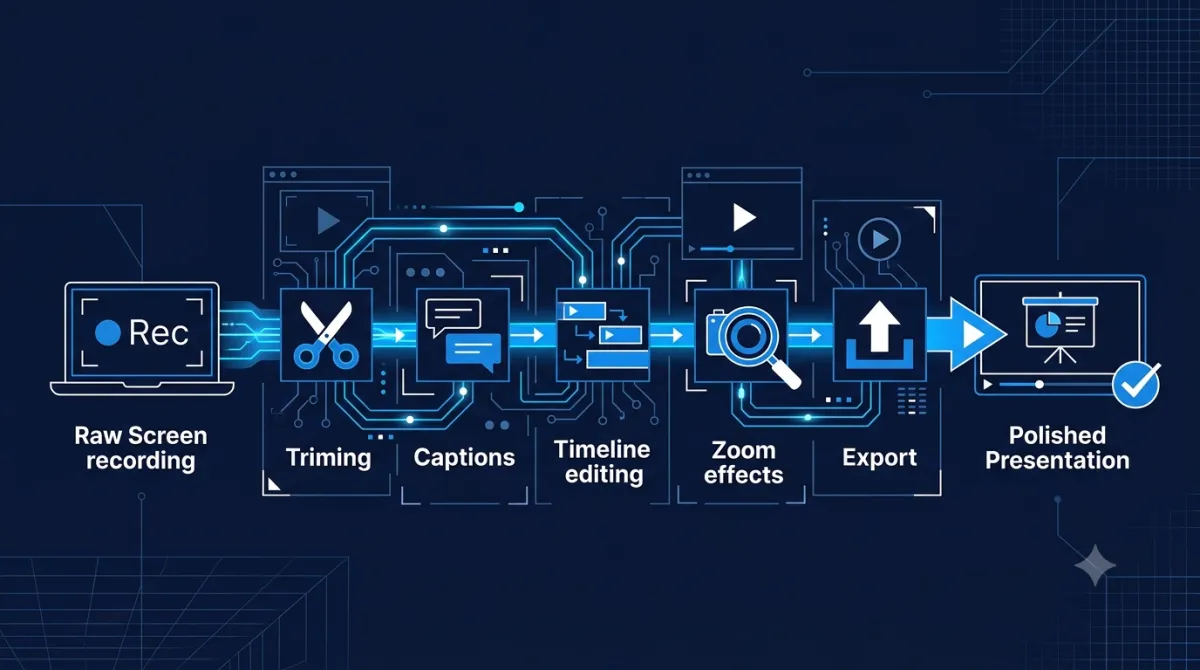
How We Turned a Raw Screen Recording Into a Product Demo With Velo 3.0
The hardest part of creating a software demo isn't recording the screen.
It's transforming a 20-minute product walkthrough into a polished two-minute video that a potential customer will actually watch.
Marketing teams typically spend more time trimming mistakes, adding callouts, inserting captions, creating zoom animations, and matching brand guidelines than they do recording the original footage. As product release cycles accelerate, that editing bottleneck becomes increasingly difficult to justify.
Velo 3.0 enters this space with a different proposition. According to TipJournal's Trend Intelligence Feed, the platform converts raw screen recordings into presentation-ready videos and quickly gained significant attention following its Product Hunt launch. Rather than asking whether AI can replace video editors, this case study explores where AI-assisted editing delivers measurable value—and where human judgment still matters.
The Workflow We Wanted to Improve
Imagine a SaaS team preparing for a new feature launch.
The goal is simple:
Publish a polished product demonstration within 24 hours of shipping the feature.
Without AI, the workflow often looks like this:
- Record the feature walkthrough.
- Remove mistakes.
- Rewrite awkward explanations.
- Add captions.
- Insert zooms and highlights.
- Improve pacing.
- Export multiple versions.
- Request stakeholder approval.
- Publish.
None of these tasks is particularly difficult.
Together, however, they create a production pipeline that can easily consume several hours for every product release.
The question wasn't whether AI could generate a perfect demo automatically.
It was whether AI could eliminate the repetitive editing work while preserving editorial quality.
Where Velo 3.0 Added the Most Value
According to the Trend Intelligence Feed, Velo 3.0 is designed to transform raw recordings into share-ready videos for product demonstrations, training, and sales enablement. That positioning aligns well with a recurring problem faced by software companies: turning internal knowledge into external content quickly.
Within this workflow, AI has the potential to automate repetitive production tasks, including:
- removing pauses and filler
- generating captions
- improving pacing
- emphasizing important interface actions
- producing multiple output versions for different channels
These tasks are highly structured and therefore well suited to automation.
The result is not necessarily a better story—it is a faster path to a publishable first draft.
That distinction matters. AI excels at accelerating production but still relies on humans to decide what deserves emphasis and how the product should be positioned.
Where Human Editors Still Outperform AI
Despite rapid progress in AI video generation, product demonstrations remain communication assets rather than purely technical outputs.
An experienced editor contributes decisions that AI cannot reliably infer, such as:
- which customer pain points deserve emphasis
- where to slow the narrative
- when to skip minor implementation details
- how to align messaging with a product launch
- what visual moments reinforce trust
AI may understand the sequence of interface actions.
It does not automatically understand the strategic importance of each action for a specific audience.
Similarly, branding decisions—including typography, pacing, transitions, and storytelling—often require consistency across every customer-facing asset.
For these reasons, Velo 3.0 is best viewed as an editing accelerator rather than a replacement for creative direction.
Evaluating AI Video Tools Beyond Feature Lists
Many product reviews focus on features.
Production teams should focus on outcomes.
When evaluating AI-powered video tools, consider measuring:
Time to first draft
How quickly can a raw recording become something suitable for internal review?
Editing effort
How much manual work remains after AI processing?
Revision cycles
Does AI reduce the number of review iterations?
Brand consistency
Can the final video match existing design and communication standards?
Scalability
Can the same workflow support weekly product launches, customer onboarding, training videos, and release announcements?
These metrics reveal operational value far more effectively than a list of editing features.
Why AI Video Infrastructure Matters
The emergence of platforms like Velo 3.0 reflects a broader shift in content production.
Product teams increasingly expect documentation, tutorials, onboarding videos, and release announcements to be generated continuously rather than as occasional marketing campaigns.
That requires infrastructure capable of shortening production cycles without sacrificing quality.
Instead of replacing professional editors, AI allows them to spend less time on repetitive mechanical tasks and more time refining messaging, narrative structure, and customer education.
This mirrors what AI coding assistants have done for software engineering: automate routine work while leaving architectural decisions to humans.
Final Thoughts
This case study intentionally evaluates Velo 3.0 as part of a production workflow rather than as an isolated product.
The platform appears well positioned for teams that regularly create product demonstrations, internal training materials, or customer education videos. Its greatest strength is likely the reduction of repetitive editing work, enabling faster iteration and more frequent publishing.
The real takeaway is not that AI now produces perfect product videos automatically. Instead, it shortens the distance between a rough screen recording and a professional first draft. For software companies shipping features every week, that reduction in production friction may prove more valuable than any single editing capability. As AI video tooling matures, the winners will be the teams that redesign their workflows—not simply those that adopt the newest tools.