
GitHub Copilot CLI Custom Agents: How Teams Turn Markdown Into Reusable AI Workflows
For most development teams, prompt engineering is still an individual activity. One developer writes a great debugging prompt, another builds a code review checklist, and someone else creates a deployment assistant—all of which remain buried in personal notes or chat history.
That approach doesn't scale.
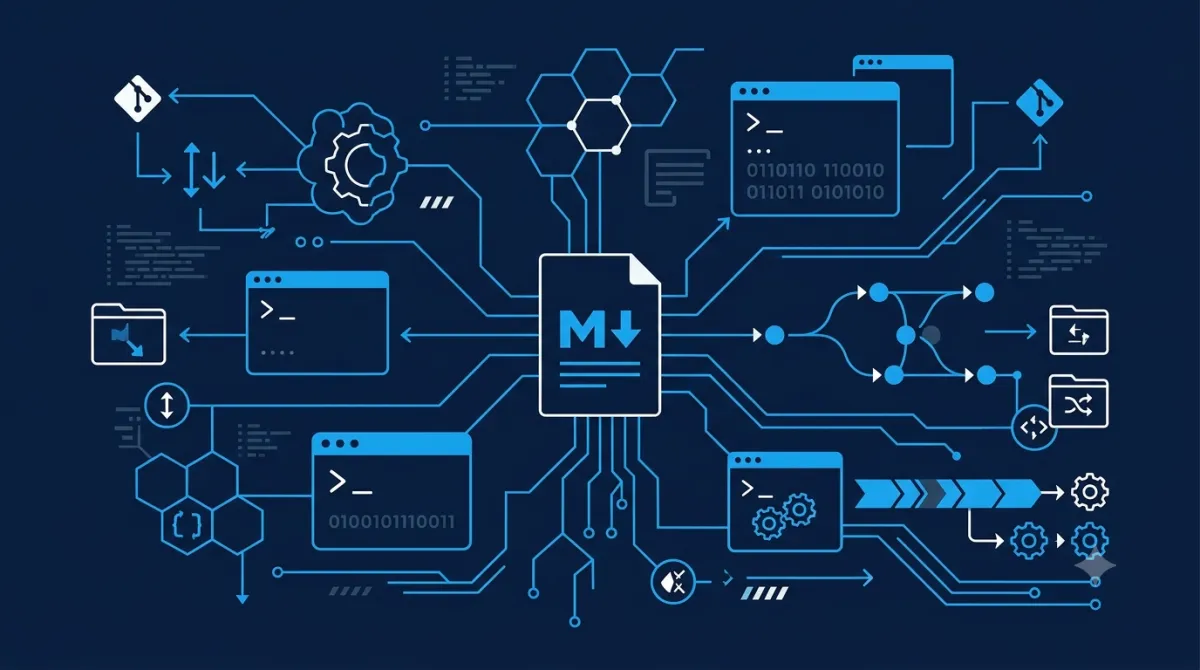
GitHub's introduction of custom agents for Copilot CLI changes the conversation by allowing teams to define reusable AI behavior in Markdown files. Instead of repeatedly explaining how an AI assistant should work, organizations can encode instructions, workflows, tools, and domain expertise into version-controlled agent profiles that every developer can share.
This isn't about replacing software engineers with autonomous agents. It's about making AI-assisted development more consistent, maintainable, and collaborative.
Markdown Turns AI Behavior Into Source Code
Developers already use Markdown to document projects, write architecture decisions, maintain runbooks, and create onboarding guides. GitHub Copilot CLI extends that familiar workflow by allowing agent profiles to be defined using Markdown files.
Each profile contains structured instructions describing how the agent should approach specific tasks, the expertise it should assume, and which tools it can access. Rather than crafting detailed prompts for every interaction, developers invoke a predefined agent that already understands the team's expectations.
Treating agent definitions as files introduces several advantages:
- Version control through Git
- Code review for AI behavior
- Collaborative improvements
- Repository-specific customization
- Consistent outputs across teams
Perhaps the most significant benefit is that AI behavior becomes part of the codebase rather than something hidden inside individual conversations. Teams can inspect, discuss, and refine agent profiles using the same engineering practices they apply to application code.
Why Reusable Agents Matter More Than Better Prompts
Large language models continue to improve, but prompt quality remains one of the biggest variables affecting output.
Without shared standards, developers often reinvent prompts for common tasks such as:
- Pull request reviews
- Security analysis
- Bug investigation
- Documentation generation
- Refactoring
- Test creation
The result is inconsistent quality and duplicated effort.
Reusable agent profiles address this by packaging proven instructions into a repeatable workflow. Instead of asking every engineer to become a prompt engineer, organizations can centralize expertise in a handful of well-designed agents.
A backend team, for example, might maintain separate agents for API design, database migrations, and performance optimization. New developers immediately benefit from established best practices without needing to discover them through trial and error.
This represents a subtle but important shift: prompts evolve from disposable conversations into reusable engineering assets.
Custom Agents Fit Naturally Into Modern Development Workflows
One reason GitHub Copilot CLI feels different from browser-based AI assistants is its emphasis on the command line.
Many development tasks already begin in the terminal:
- navigating repositories
- inspecting logs
- running tests
- executing scripts
- managing Git
- interacting with build systems
Embedding custom agents into this environment reduces context switching. Developers don't need to leave their workflow to explain a task to an external chatbot. Instead, they invoke an agent that understands the repository, follows predefined instructions, and operates within the CLI.
For organizations standardizing development practices, this can improve consistency across multiple repositories. Teams working on microservices, for instance, can maintain repository-specific agents while sharing common standards for testing, security reviews, or documentation.
The approach also complements infrastructure-as-code principles by treating AI configuration as another artifact that can be reviewed, versioned, and deployed alongside software.
Custom Agents Are Powerful—but They're Not Autonomous Developers
The term "AI agent" often suggests a system capable of independently completing complex projects with little human oversight. GitHub's implementation is more practical.
Custom agents guide how Copilot CLI responds to requests, but they don't eliminate the need for engineering judgment. Developers remain responsible for reviewing generated code, validating architectural decisions, and ensuring outputs align with business requirements.
Teams should also recognize several limitations:
- Agent quality depends on the clarity of its instructions.
- Outdated profiles can propagate obsolete practices.
- Repository context remains essential for accurate responses.
- Generated code still requires testing and review.
In other words, Markdown-based agents improve consistency—they don't replace established software engineering disciplines.
Organizations adopting this feature should view it as a productivity enhancement rather than a substitute for peer review or automated testing.
AI Configuration Is Becoming Part of the Software Lifecycle
The broader significance of GitHub Copilot CLI's custom agents isn't the Markdown syntax—it's what the syntax represents.
Engineering teams are beginning to manage AI behavior the same way they manage source code, infrastructure, and deployment pipelines. Prompt engineering is evolving into configuration management.
That opens the door to practices that already feel familiar:
- reviewing agent changes through pull requests
- versioning AI workflows alongside application code
- maintaining organization-wide standards
- sharing domain expertise across teams
- continuously improving AI-assisted development
As more development platforms adopt configurable AI workflows, organizations may find themselves maintaining libraries of specialized agents just as they maintain internal frameworks or reusable components today.
The competitive advantage won't come from having access to the most capable language model. It will come from encoding organizational knowledge into reusable workflows that every developer can leverage.
Final Recommendation
GitHub Copilot CLI's custom agents demonstrate a practical evolution in AI-assisted software development. By allowing teams to define reusable AI workflows in Markdown, GitHub shifts prompt engineering from an individual habit to a collaborative engineering practice.
For teams already using Git and the command line as the center of their development workflow, this approach offers a natural way to standardize AI assistance without introducing entirely new tooling. Agent profiles can be reviewed, versioned, and improved like any other project artifact, making AI behavior more transparent and maintainable.
The long-term value isn't that Markdown creates smarter AI. It's that version-controlled agent profiles allow organizations to preserve institutional knowledge, reduce repetitive prompting, and build consistent development workflows that scale across teams. As AI becomes a permanent part of software engineering, treating prompts as reusable infrastructure may prove just as important as choosing the underlying language model.