

Introduction: The Next Chapter in Large Language Models
The landscape of artificial intelligence has undergone a remarkable transformation over the past few years, with large language models evolving from experimental research projects into indispensable tools that shape how millions of people work, create, and communicate. From the early days of GPT-2 to the sophisticated reasoning engines of 2026, each generation of models has pushed the boundaries of what machines can understand and generate. Among the most compelling narratives in this ongoing evolution is the rise of Chinese AI laboratories, which have increasingly demonstrated their capacity to produce frontier-grade models that compete with the very best from Silicon Valley and London.
Z.ai, the commercial arm of Tsinghua University-backed Zhipu AI, has been at the forefront of this movement. Its GLM series—short for General Language Model—has progressed through several major iterations in rapid succession. GLM-4 established the franchise as a credible alternative to Western models, particularly in Chinese-language tasks. GLM-5, released in early 2026, marked a decisive shift toward agentic engineering and complex systems design, moving beyond simple text generation to tackle multi-step, long-horizon tasks that require planning, tool use, and iterative refinement. GLM-5.1 followed just weeks later, sharpening the model's coding capabilities and extending its reasoning reach.
Now, with the arrival of GLM-5.2 on June 13, 2026, Z.ai has delivered what may be its most ambitious release yet. At first glance, the headline feature is staggering: a one-million-token context window that dwarfs anything currently available from competitors. But context length alone does not define a model's quality. This review takes a thorough, balanced look at GLM-5.2—examining its real-world applications, its genuine strengths, and the areas where it still falls short—to help general tech readers understand where this model truly stands in the competitive landscape.
What's New in GLM 5.2
GLM-5.2 represents a significant architectural leap from its predecessors. At its core, the model is built as a 744-billion-parameter Mixture-of-Experts (MoE) system, with approximately 40 billion active parameters engaged per token during inference. This design philosophy—maintaining a large total parameter count for broad knowledge coverage while activating only a focused subset for each forward pass—strikes an effective balance between capability and computational efficiency. The MoE approach allows GLM-5.2 to deliver performance that rivals much denser models while keeping inference costs manageable.
The 1-Million-Token Context Window
The single most talked-about feature of GLM-5.2 is its 1,000,000-token context window, available through the glm-5.2[1m] endpoint. To put this in perspective, one million tokens roughly corresponds to 750,000 English words—enough to ingest several full-length novels, entire codebases, or comprehensive legal documents in a single session. This is five times larger than GPT-5.2's context window and represents a generational leap in how much information the model can process coherently at once. The model also supports a maximum output of 131,072 tokens, enabling it to generate extensive responses, complete large files, or produce detailed analyses in a single turn.
However, a large context window is only valuable if the model can actually use it effectively. Historical experience with long-context models has shown that performance often degrades as the context grows—a phenomenon sometimes called the "lost in the middle" problem, where information buried deep within a long prompt is overlooked. Early community testing of GLM-5.2 suggests that its retrieval accuracy remains strong even at the extremes of its context window, though rigorous independent benchmarking is still pending. The practical upshot is that developers can feed entire repositories of documentation into the model and expect reasonably faithful recall across the full span.
Two Thinking-Effort Levels
Another noteworthy innovation is the introduction of two distinct thinking-effort levels. When faced with a straightforward query—say, a simple factual question or a minor code fix—the model can operate in a low-effort mode that prioritizes speed and efficiency, delivering responses in seconds with minimal computational overhead. For more complex tasks—multi-step reasoning problems, intricate code refactoring, or detailed analytical work—the model switches to a high-effort mode that engages deeper chain-of-thought processing, trading latency for thoroughness and accuracy. This dual-mode approach gives developers fine-grained control over the cost-quality trade-off, allowing them to allocate computational resources where they matter most.
Open Weights and Ecosystem
Z.ai has announced that GLM-5.2 will be released under an MIT license, with model weights made publicly available. This is a meaningful commitment to open science, especially notable given the model's frontier-grade capabilities. The open-weights approach enables researchers, startups, and independent developers to fine-tune, distill, or deploy the model on their own infrastructure without licensing restrictions. While the weights are still pending release at the time of writing, the announcement signals Z.ai's confidence that openness and commercial viability are not mutually exclusive. The model is accessible immediately through the GLM Coding Plan across four tiers: Lite, Pro, Max, and Team.
Real-World Applications
Understanding a model's capabilities on paper is one thing; seeing how it performs in practical, everyday scenarios is quite another. GLM-5.2 was designed with a strong emphasis on coding and agentic workflows, and its architecture reflects this priority. In the sections below, we examine the use cases where the model truly shines, as well as those where its strengths are more nuanced.
Enterprise Code Generation and Refactoring
GLM-5.2's most compelling real-world application lies in professional software engineering. The model's deep context window allows it to ingest entire codebases—hundreds of thousands of lines of code, along with documentation, test files, and configuration scripts—and reason about them holistically. This is a qualitative shift from earlier models, which could handle individual files or small modules but struggled to maintain coherence across large, interdependent projects. With GLM-5.2, developers can ask questions like "Refactor the authentication module to support OAuth 2.0 without breaking existing session-based logins" and receive responses that account for downstream effects across the entire repository.
Early adopters have reported that GLM-5.2 excels particularly at what might be called "architectural reasoning"—understanding not just what individual functions do, but how components relate to one another, where dependencies create coupling, and how changes propagate through a system. This makes it especially valuable for legacy code modernization, where understanding the full context of a decades-old system is essential before making any modifications.
Research and Document Analysis
The 1M-token context window opens up transformative possibilities for researchers, analysts, and legal professionals who need to synthesize information across vast document collections. A biomedical researcher can load dozens of full-length research papers into a single session and ask the model to identify contradictory findings, summarize methodological trends, or highlight gaps in the literature. A legal team can upload an entire contract portfolio and request a comparative analysis of liability clauses across jurisdictions. These are tasks that previously required painstaking manual review or the use of specialized retrieval-augmented generation (RAG) systems; GLM-5.2 makes them possible through direct prompting.
Multilingual Content Creation
As a model developed by a Chinese AI laboratory with global ambitions, GLM-5.2 offers robust multilingual capabilities. It handles Chinese and English with near-native fluency and performs well across a range of other languages, including Japanese, Korean, French, German, and Spanish. Content creators working in multilingual environments—producing marketing materials that need to resonate across Asian and Western markets, for instance—will find GLM-5.2's ability to maintain tone, nuance, and cultural context across languages genuinely useful. The model's bilingual strength also makes it an excellent tool for translation quality assurance, where it can cross-reference source and target texts simultaneously.
Application Suitability Overview
| Application Area | Suitability | Key Advantage |
|---|---|---|
| Large-Scale Code Refactoring | Excellent | 1M context ingests entire repos |
| Research Literature Synthesis | Excellent | Long-context document analysis |
| Agentic Task Orchestration | Very Good | Built-in tool use and planning |
| Multilingual Content | Very Good | Strong CJK + English fluency |
| Creative Writing | Good | Decent style control, limited flair |
| Real-Time Conversation | Moderate | Latency in high-effort mode |
Table 1: GLM 5.2 Application Suitability Overview
Strengths That Set GLM 5.2 Apart
Every frontier model has a distinctive profile—a set of capabilities where it genuinely outperforms its peers. For GLM-5.2, several qualities stand out as particularly noteworthy, each reflecting deliberate architectural and training decisions by the Zhipu AI team.
Unmatched Context Length
The 1M-token context window is not merely a marketing specification; it represents a fundamental expansion of what is possible with a single model invocation. While competitors like GPT-5.2 and Claude offer context windows in the 200K range, GLM-5.2's million-token capacity means that tasks requiring cross-referencing across massive documents—legal discovery, academic literature reviews, enterprise code audits—can be accomplished without the fragmentation and context-loss inherent in chunking strategies. This is a genuine competitive advantage that is difficult to overstate for certain professional workflows.
Coding and Agentic Proficiency
Building on the agentic engineering foundation laid by GLM-5 and GLM-5.1, GLM-5.2 demonstrates strong performance in complex, multi-step coding tasks. The model can plan a solution architecture before writing code, handle intricate refactors that span multiple files, and recover from errors through iterative self-correction. Community benchmarks, while not officially published by Z.ai, suggest scores around 77.8% on SWE-Bench Verified and 82% on LiveCodeBench, placing it in the upper echelon of coding models. Its agentic capabilities—the ability to use tools, follow multi-step plans, and maintain state across long task chains—make it particularly well-suited for autonomous coding agents that need minimal human oversight.
Cost-Efficiency Through MoE
The Mixture-of-Experts architecture delivers a compelling cost-to-capability ratio. By activating only 40 billion of its 744 billion total parameters per token, GLM-5.2 achieves performance comparable to much denser models while consuming significantly fewer computational resources per query. This translates into lower per-token pricing, making it an attractive option for high-volume applications where cost matters as much as quality. For startups and independent developers operating under budget constraints, this efficiency can be the difference between a viable product and an unsustainable one.
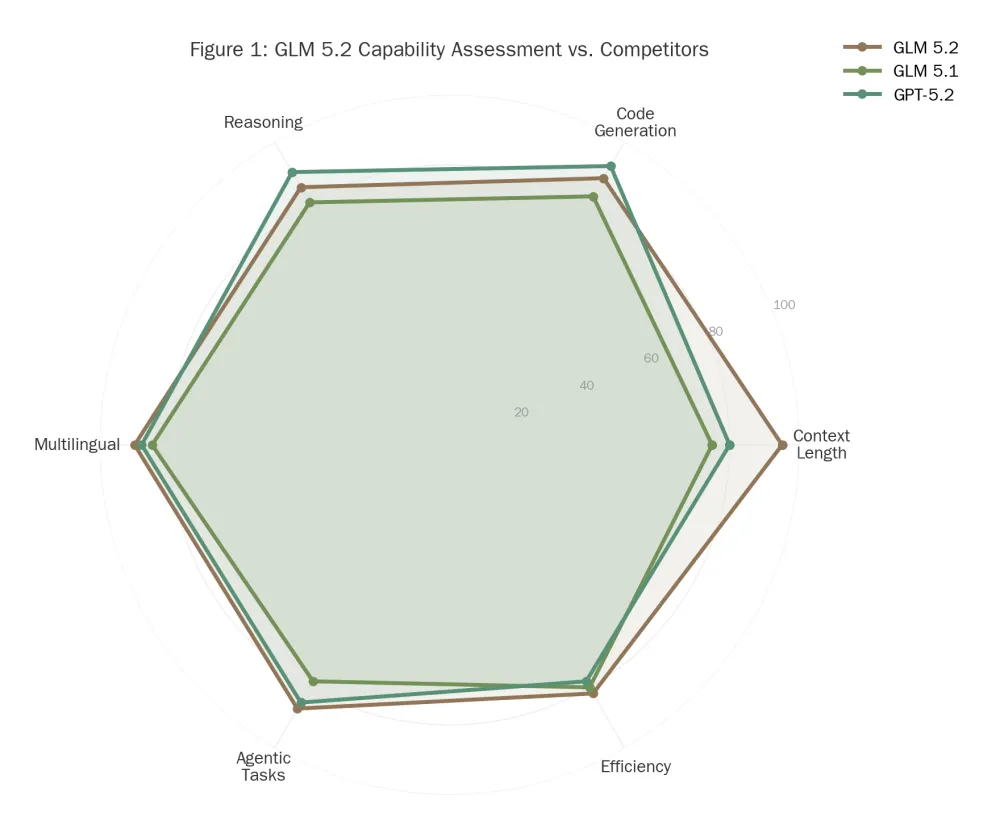 Figure 1: GLM 5.2 capability assessment compared to GLM 5.1 and GPT-5.2. Scores represent relative performance on a 0–100 scale across key dimensions.
Limitations and Areas for Improvement
No model is without its shortcomings, and a credible review must address them with the same rigor applied to its strengths. GLM-5.2, for all its impressive capabilities, has several notable limitations that prospective users should understand before committing to it as their primary AI tool.
The Benchmark Transparency Gap
Perhaps the most immediately striking limitation is the absence of official benchmarks at launch. Z.ai published zero benchmark scores for GLM-5.2 on release day, an unusual decision for a frontier model announcement. While community members have since run independent evaluations, the lack of vendor-verified numbers makes it difficult to make direct, confident comparisons with competitors. This opacity stands in contrast to the practices of OpenAI, Anthropic, and Google, which typically release detailed benchmark results alongside their models. The absence may reflect a deliberate strategy to let the model speak for itself through real-world usage, but it also means that potential adopters must invest their own time in evaluation before making informed decisions.
Latency in High-Effort Mode
When operating in its high-effort thinking mode, GLM-5.2 can be notably slow. Community reports indicate average response times of approximately 150 seconds for complex coding tasks in high-effort mode, significantly longer than competitors like GPT-5.2 or Claude. For applications that require real-time interaction—pair programming assistants, conversational agents, or interactive debugging tools—this latency can be a serious impediment. The low-effort mode is faster but sacrifices the deep reasoning that distinguishes the model from cheaper alternatives. Finding the right balance between speed and quality for a given use case requires experimentation and may not always yield a satisfactory compromise.
Hallucination and Factual Reliability
Like all large language models, GLM-5.2 is susceptible to hallucination—generating confident but incorrect information, particularly in specialized domains where its training data may be sparse. While the long context window helps reduce certain types of hallucination (by allowing the model to reference large amounts of provided context rather than relying on memorized facts), it does not eliminate the problem entirely. Users report that the model occasionally fabricates API signatures, misattributes citations, or invents plausible-sounding but nonexistent research findings. For mission-critical applications in healthcare, finance, or legal domains, these errors necessitate thorough human review of all model outputs.
Niche Domain Gaps
Despite its broad capabilities, GLM-5.2 shows noticeable weaknesses in certain specialized domains. Its knowledge of niche programming languages, obscure scientific subfields, and low-resource languages is less comprehensive than its coverage of mainstream topics. Mathematical reasoning, while improved over previous versions, still lags behind the best-in-class models, particularly on competition-level problems that require creative problem-solving rather than straightforward application of known techniques. These gaps are not unique to GLM-5.2—they reflect the general challenge of training data coverage—but they are worth noting for users whose work falls outside the model's core strengths.
The Competitive Landscape
GLM-5.2 enters a fiercely competitive market. Understanding its position requires looking beyond raw specifications to consider how it compares with the leading frontier models across the dimensions that matter most to practitioners.
Against GPT-5.2, GLM-5.2's primary advantage is its context window: one million tokens versus approximately 200,000. For tasks that demand processing vast amounts of text or code in a single session, this is a decisive edge. However, GPT-5.2 generally leads on standard coding and reasoning benchmarks, and its inference speed in standard mode is significantly faster. Against Claude, the comparison is more nuanced. Claude's reputation for nuanced, thoughtful responses and its strong performance on complex reasoning tasks make it a preferred choice for many analytical applications, though its context window is also smaller than GLM-5.2's. Gemini 3 offers competitive benchmark scores and deep integration with Google's ecosystem, making it the natural choice for users already embedded in that environment.
What distinguishes GLM-5.2 from all of these competitors is its combination of open weights, massive context, and cost efficiency. No other model currently offers this particular trifecta. For organizations that prioritize sovereignty over their AI infrastructure—the ability to run models on-premises, fine-tune on proprietary data, and avoid vendor lock-in—GLM-5.2's MIT-licensed open weights represent a genuinely unique value proposition.
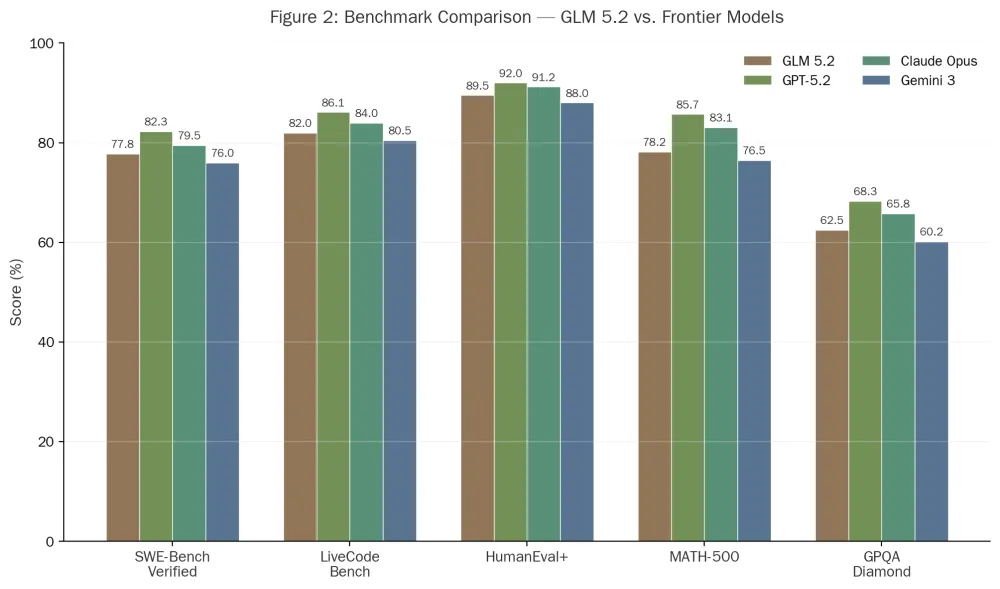 Figure 2: Benchmark comparison across frontier models. Scores are based on community evaluations and publicly available datasets. GLM 5.2 scores are unofficial.
| Feature | GLM 5.2 | GPT-5.2 | Claude Opus | Gemini 3 |
|---|---|---|---|---|
| Context Window | 1,000,000 | ~200,000 | ~200,000 | ~1,000,000 |
| Max Output Tokens | 131,072 | ~32,768 | ~64,000 | ~65,536 |
| Open Weights | MIT (pending) | No | No | No |
| Architecture | 744B MoE | Undisclosed | Undisclosed | Undisclosed |
| Active Parameters | ~40B/token | N/A | N/A | N/A |
| Thinking Modes | 2 levels | Adaptive | Extended | Adaptive |
| Pricing Model | Per-token (4 tiers) | Per-token | Per-token | Per-token |
Table 2: Feature Comparison of Frontier Models (June 2026)
Conclusion and Outlook
GLM-5.2 is a model defined by superlatives and qualifications in equal measure. Its one-million-token context window is genuinely groundbreaking, offering capabilities that simply do not exist elsewhere in the market today. Its Mixture-of-Experts architecture delivers a cost-efficiency profile that makes frontier-grade AI accessible to a broader range of organizations and developers. Its commitment to open weights under an MIT license is a refreshing contrast to the proprietary approaches of its largest competitors and signals a maturing open-source AI ecosystem.
At the same time, the model is not without its challenges. The absence of official benchmarks at launch creates uncertainty that hampers adoption for risk-averse organizations. Latency in high-effort thinking mode limits its suitability for real-time applications. And like all current large language models, it remains vulnerable to hallucination and gaps in specialized knowledge that demand careful human oversight.
Looking ahead, GLM-5.2's trajectory is promising. Zhipu AI has demonstrated an impressive cadence of releases—three major model versions in roughly three months—suggesting that rapid iteration and improvement will continue. The pending release of model weights will likely catalyze a wave of community fine-tuning, benchmarking, and application development that could address many of the current limitations. If Z.ai can close the benchmark transparency gap and optimize inference speed without sacrificing reasoning depth, GLM-5.2 could evolve from an impressive technical achievement into a genuinely indispensable tool for developers, researchers, and enterprises worldwide. For now, it stands as a compelling option for those whose workflows demand extreme context length, cost efficiency, or open-weights deployment—and a worthy contender in the increasingly competitive arena of frontier AI models.