
Model Context Protocol Explained: Why MCP Could Become AI's USB-C Standard
Every new AI application seems to repeat the same engineering work.
Connect to a database.
Authenticate with an API.
Read local files.
Query a knowledge base.
Search GitHub.
Access Slack.
Integrate a CRM.
The language model may change, but the integration layer rarely does.
As AI assistants evolve into systems capable of interacting with dozens—or even hundreds—of external tools, maintaining custom integrations becomes increasingly difficult. Every provider introduces different authentication methods, SDKs, request formats, and permission models.
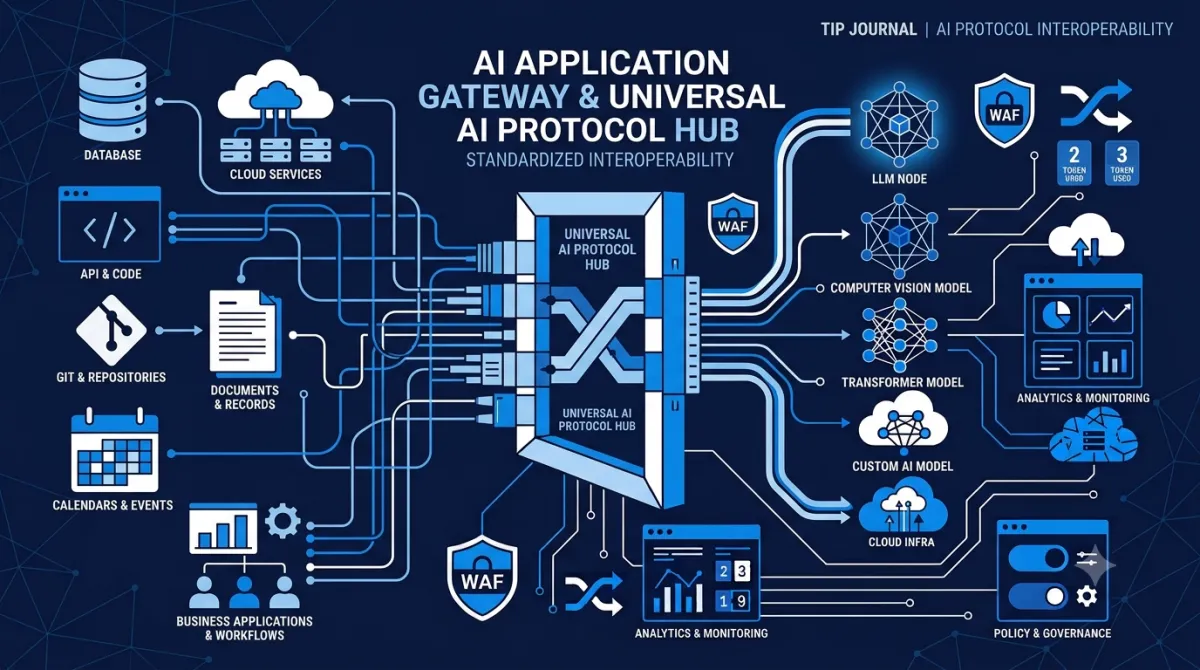
The Model Context Protocol (MCP) attempts to solve this problem by introducing a standardized way for AI models to communicate with external systems. Instead of building a unique connector for every model and every application, developers can build against a shared protocol.
Whether MCP becomes the industry's dominant standard remains to be seen, but its underlying idea addresses one of the biggest engineering challenges facing production AI.
The Integration Problem Is Growing Faster Than Model Capabilities
Language models have improved dramatically over the past two years.
Enterprise integrations have not.
A modern AI assistant might need access to:
- documentation
- code repositories
- project management systems
- cloud infrastructure
- internal databases
- customer records
- calendars
- ticketing platforms
Without a common interface, every integration becomes another maintenance burden.
Organizations quickly find themselves supporting dozens of bespoke connectors, each requiring updates whenever APIs change or new providers are introduced.
The result is increasing operational complexity rather than increasing AI capability.
The more successful an AI deployment becomes, the more painful this integration problem tends to be.
Model Context Protocol Explained: What MCP Actually Standardizes
A common misconception is that MCP is another language model.
It isn't.
Nor is it a replacement for existing APIs.
Instead, MCP defines a common protocol through which AI applications can discover available tools, exchange structured context, invoke capabilities, and receive responses in a consistent way.
Conceptually, it separates tool access from model implementation.
Rather than teaching every model how to interact with every external service independently, developers expose those services through MCP-compatible servers.
The benefits include:
- standardized tool discovery
- consistent request formats
- simplified integration logic
- reusable connectors
- improved portability across models
Applications become less dependent on the implementation details of individual AI providers.
Why "AI's USB-C" Is a Useful Analogy
USB-C did not invent charging.
It did not invent data transfer.
It standardized how devices connected.
That standardization dramatically reduced complexity for both manufacturers and consumers.
The comparison with MCP follows the same principle.
Today, every AI platform tends to implement tool access differently.
If multiple models adopt the same protocol, developers can spend less time rewriting integrations and more time improving application logic.
The analogy is helpful because it emphasizes interoperability rather than performance.
Just as USB-C simplified the hardware ecosystem, MCP aims to simplify the software ecosystem surrounding AI.
The comparison is not perfect—hardware standards and software protocols evolve under different technical and governance constraints—but it illustrates the architectural goal.
What Engineering Teams Should Evaluate Before Adopting MCP
Adopting a protocol should never be driven by hype alone.
Before introducing MCP into production systems, teams should evaluate several practical considerations.
Security
How are permissions managed?
Can tool access be restricted by user, application, or environment?
Does the protocol integrate with existing identity and access management systems?
Governance
Can administrators audit tool usage?
Are requests logged consistently?
Can organizations enforce policies around sensitive resources?
Scalability
How does the architecture perform when hundreds of tools are available?
Can discovery remain efficient without overwhelming the model?
Ecosystem Support
Protocol adoption matters as much as protocol design.
Evaluate which AI providers, developer frameworks, and enterprise platforms already support MCP or have announced plans to do so.
Developer Experience
The strongest technical standard often wins because it reduces developer friction.
Documentation, SDK quality, debugging tools, and community adoption all influence long-term success.
MCP Is Part of a Larger Shift Toward Standardized AI Infrastructure
The emergence of MCP reflects a broader trend in enterprise AI.
Organizations are moving away from tightly coupled AI applications toward modular architectures where models, tools, gateways, evaluation systems, and observability platforms operate as interchangeable components.
This mirrors previous transitions in software engineering.
Cloud computing standardized infrastructure.
Containers standardized deployment.
API gateways standardized service access.
Now AI platforms are beginning to standardize model interactions.
Whether MCP ultimately becomes the dominant protocol or one of several competing standards, the industry direction is becoming clear: interoperability is replacing custom integration as the preferred architectural pattern.
Final Thoughts
The most important innovation behind the Model Context Protocol is not a new model capability. It is the recognition that AI systems need common interfaces if they are to scale across enterprise environments.
This guide to the Model Context Protocol argues that its long-term value lies in reducing integration complexity rather than improving model intelligence. The "AI's USB-C" analogy captures that ambition: a shared standard that allows models and tools to work together more predictably.
Organizations evaluating MCP should focus less on whether it is fashionable today and more on whether it fits a long-term strategy of modular, provider-agnostic AI infrastructure. If that trend continues, standardized protocols may become just as important to enterprise AI as the models themselves.