
Most AI agents don't fail because the underlying language model is bad.
They fail because nobody notices when their behavior changes.
A new prompt is deployed. A model version is updated. A retrieval index grows. A tool API changes. Costs increase. Response latency doubles. Suddenly an agent that solved 95% of tasks yesterday now succeeds only 70% of the time.
Unlike traditional software, AI systems rarely break with obvious exceptions. They drift. They become inconsistent. They succeed just often enough to make failures difficult to detect.
This is why best AI agent testing tools 2026 has become more than a search query—it's becoming one of the most important engineering questions in LLMOps.
Leading AI teams increasingly treat evaluation as a continuous engineering discipline rather than a final QA step.
AI Agents Need a Different Testing Philosophy
Software engineering has decades of mature testing practices.
You write unit tests.
You write integration tests.
You deploy regression suites.
AI agents require all of those—and something entirely new.
An agent is not simply executing deterministic logic. It reasons, chooses tools, interprets user intent, retrieves information, and makes decisions under uncertainty. Every layer introduces variability.
Instead of asking:
"Does this function return the correct value?"
Engineers increasingly ask:
- Did the agent choose the correct tool?
- Was the reasoning chain appropriate?
- Did retrieval provide useful context?
- Did the final answer satisfy the user's intent?
- Was the answer safe?
- Was the cost acceptable?
- Could another model perform the same task more efficiently?
These questions cannot be answered with conventional software tests alone.
Modern AI evaluation therefore combines deterministic software testing with probabilistic quality assessment.
Continuous Evaluation Is Replacing One-Time Benchmarks
Early LLM projects often relied on benchmark scores.
Teams compared models using MMLU, HumanEval, GSM8K, or other public leaderboards before selecting one for production.
Those benchmarks remain useful.
They are no longer sufficient.
Production agents interact with proprietary knowledge bases, enterprise APIs, internal workflows, and unpredictable human requests. Their quality depends far more on system design than benchmark performance.
Modern evaluation pipelines therefore emphasize continuous measurement.
Instead of asking whether GPT, Claude, Gemini, or another model scored highest on a benchmark six months ago, teams ask:
- Is today's deployment better than yesterday's?
- Did the latest prompt reduce failures?
- Did retrieval quality improve?
- Did latency increase?
- Did costs rise?
- Did customer satisfaction change?
This shift mirrors the evolution of DevOps.
Software teams stopped relying on manual testing years ago.
AI teams are beginning to do the same.
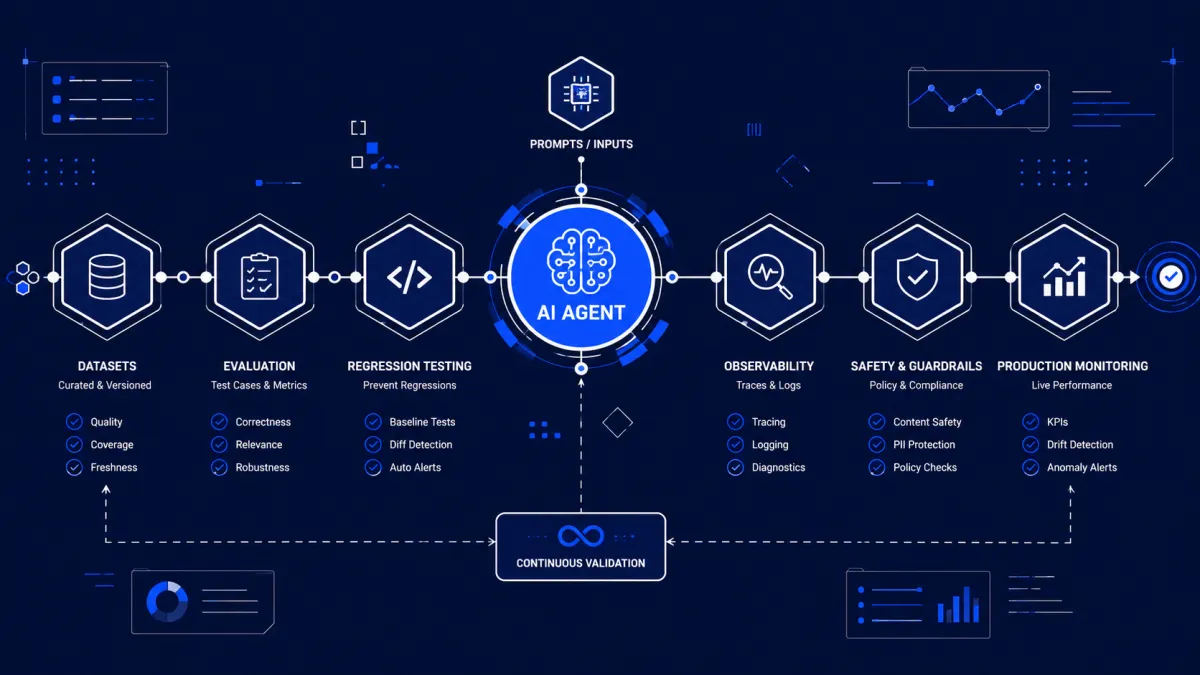
The Five Layers of an Effective Agent Evaluation Pipeline
The strongest production teams rarely depend on a single testing framework.
Instead, they evaluate AI systems across multiple layers.
1. Prompt Regression
Every prompt modification should be evaluated against historical datasets.
Small wording changes frequently produce surprisingly large behavioral differences.
Regression testing prevents improvements in one workflow from silently degrading another.
2. Task Success
Can the agent actually complete the intended objective?
Task completion is often the highest-value metric because users care about outcomes rather than intermediate reasoning.
For customer support agents this may mean successfully resolving tickets.
For coding agents it may mean producing compiling code.
For browser agents it may mean finishing an automation workflow.
3. Tool Execution
Many failures occur before reasoning becomes the problem.
Agents increasingly interact with APIs, databases, browsers, terminals, calendars, CRMs, or internal enterprise systems.
Evaluation therefore measures:
- correct tool selection
- parameter accuracy
- execution success
- recovery after failures
- retry effectiveness
An agent that reasons perfectly but repeatedly invokes the wrong API is still unreliable.
4. Safety and Policy Compliance
Enterprise deployments introduce another evaluation layer.
Does the agent expose confidential information?
Does it ignore access controls?
Does it hallucinate legal advice?
Does it generate unsafe outputs?
Safety evaluation is becoming mandatory rather than optional as AI adoption expands into regulated industries.
5. Production Monitoring
The final layer never ends.
After deployment, teams continuously monitor:
- success rate
- latency
- token consumption
- operational cost
- user feedback
- failure clusters
- unexpected behaviors
The objective is not perfection.
It is early detection.
The fastest teams identify regressions within hours instead of weeks.
What the Leading Evaluation Platforms Actually Do
Although dozens of products now advertise AI evaluation capabilities, most fall into several distinct categories.
Experiment Tracking Platforms
These platforms compare prompts, models, datasets, and experiments across multiple iterations.
They help teams understand whether a change genuinely improved performance instead of relying on intuition.
Examples include platforms focused on experiment management and evaluation dashboards.
LLM Evaluation Frameworks
These frameworks automate quality scoring.
Rather than asking humans to inspect thousands of outputs manually, evaluation frameworks score correctness, relevance, faithfulness, toxicity, hallucination risk, and other quality signals.
Most integrate directly into CI/CD pipelines.
This makes evaluation repeatable rather than subjective.
Observability Platforms
Once systems reach production, observability becomes critical.
These platforms monitor live agent behavior, detect regressions, identify expensive prompts, analyze traces, and surface recurring failure patterns before they become customer issues.
Observability complements testing rather than replacing it.
Together they create continuous feedback loops.
Best AI Agent Testing Tools in 2026: Choosing the Right Platform
No single evaluation platform solves every problem.
The right choice depends on where your team is in the AI development lifecycle. Some tools excel at experiment tracking, others focus on automated evaluation, while a third category specializes in production observability.
The most mature organizations combine multiple tools rather than relying on one platform.
| Tool | Best For | Strengths | Limitations |
|---|---|---|---|
| Opik | End-to-end LLM evaluation | Open source, experiment tracking, prompt comparison, production evaluation | Smaller ecosystem than older platforms |
| LangSmith | LangChain-based applications | Excellent tracing, debugging, evaluation workflows | Best experience within the LangChain ecosystem |
| Braintrust | Production evaluation | Dataset management, human feedback loops, regression testing | Commercial-first platform |
| DeepEval | Automated testing | CI/CD integration, assertion-based evaluation, open source | Focused primarily on automated testing rather than observability |
| Promptfoo | Prompt regression | Lightweight, model comparison, Git-friendly | Limited production monitoring |
| Phoenix (Arize) | Observability | Trace visualization, retrieval debugging, production monitoring | Requires instrumentation for maximum value |
| MLflow | Experiment management | Mature ML lifecycle tooling, model tracking | Not purpose-built for AI agents |
Opik: A Strong Open-Source Default
Among the newer entrants, Opik has gained traction because it combines several capabilities that previously required multiple tools.
Teams can:
- Compare prompt versions
- Evaluate different models
- Track experiments
- Build evaluation datasets
- Monitor production behavior
- Review traces
For engineering teams already comfortable with open-source infrastructure, Opik provides an attractive balance between flexibility and operational visibility.
Its growing ecosystem also makes it easier to integrate evaluation into existing development workflows without locking teams into proprietary infrastructure.
LangSmith: The Natural Choice for LangChain Teams
If an organization already builds agents using LangChain, LangSmith remains one of the strongest debugging experiences available.
Its detailed execution traces help engineers answer questions like:
- Why did the agent choose this tool?
- Which retrieval step failed?
- Which prompt generated the hallucination?
- Where did latency increase?
Tracing becomes increasingly valuable as workflows evolve from simple chatbots into multi-agent systems.
Rather than inspecting logs manually, developers can replay execution paths and identify regressions much faster.
DeepEval and Promptfoo Bring Testing Into CI/CD
Software teams already understand continuous integration.
AI teams are beginning to apply the same discipline.
DeepEval and Promptfoo allow evaluations to run automatically whenever prompts, models, or workflows change.
Instead of deploying first and hoping nothing breaks, every pull request can execute predefined evaluation suites.
Typical automated checks include:
- factual consistency
- answer relevance
- hallucination detection
- tool correctness
- response quality
- latency thresholds
Evaluation gradually becomes another stage in the deployment pipeline rather than a manual review process.
Build an Evaluation Stack Instead of Buying One Tool
One recurring mistake is treating evaluation as a purchasing decision.
In reality, it is an architectural decision.
High-performing teams usually combine complementary layers:
Development
- Prompt regression
- Unit evaluation
- Dataset management
↓
Continuous Integration
- Automated evaluation
- Safety testing
- Cost regression
- Performance benchmarks
↓
Production
- Tracing
- Monitoring
- User feedback
- Failure clustering
- Continuous improvement
Each layer answers different questions.
No single product currently provides best-in-class capabilities across every stage.
Metrics That Actually Predict Production Success
Many dashboards expose dozens of metrics.
Only a handful consistently influence production quality.
The most valuable indicators include:
- Task completion rate
- Tool execution accuracy
- Retrieval precision
- Hallucination frequency
- Human preference score
- Average latency
- Cost per successful task
- Retry rate
- Escalation rate
- User satisfaction
Notice what is missing.
Very few production teams optimize for benchmark scores once systems are deployed.
Instead, they optimize for business outcomes.
An agent that solves customer problems reliably at half the inference cost often delivers far more value than one with marginally higher benchmark performance.
Common Evaluation Mistakes
Many organizations still evaluate agents as if they were conventional software.
Common pitfalls include:
Measuring only model quality
Language models are only one component.
Failures frequently originate from retrieval systems, APIs, orchestration logic, memory, or external tools.
Testing with synthetic prompts only
Real users behave differently from benchmark datasets.
Production evaluations should include representative customer interactions.
Ignoring regressions
Prompt updates often improve one workflow while degrading another.
Without historical evaluation datasets, these regressions remain invisible.
Waiting until production
Evaluation should begin during development—not after deployment.
Continuous testing dramatically reduces expensive production failures.
Final Thoughts
As AI systems evolve from chat interfaces into autonomous workflows, evaluation is becoming one of the defining engineering disciplines of the decade.
Choosing the best AI agent testing tools 2026 is less about finding a single winner and more about building a repeatable evaluation pipeline that fits your architecture, development process, and operational requirements.
Organizations that invest in continuous evaluation today will spend less time firefighting regressions, recover faster from model changes, and ship more reliable AI products. In practice, the strongest AI teams are not those using the most powerful language models—they are the ones with the best feedback loops.