
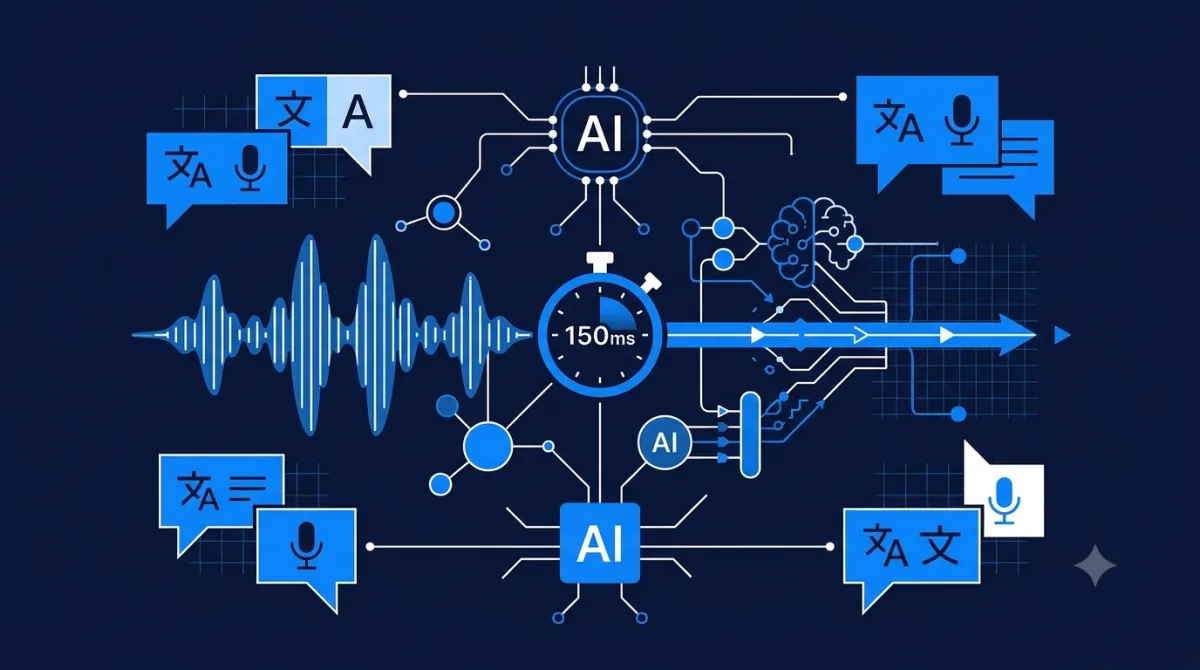
ElevenLabs Scribe V2 Realtime Review: Can 150ms Transcription Power Production AI Agents?
For years, speech recognition has been treated as an isolated feature—a way to generate meeting notes or dictate text. AI agents change that assumption. When an agent needs to listen, reason, call tools, and respond naturally, transcription becomes part of a latency budget rather than an independent service.
Every hundred milliseconds matters.
ElevenLabs Scribe V2 Realtime is positioned around this shift. According to TipJournal's editorial intelligence, the model targets approximately 150ms transcription latency while supporting more than 90 languages, making it one of the most notable speech infrastructure launches in recent months. Rather than asking whether it produces accurate transcripts, the more useful question for practitioners is whether it is fast and reliable enough to serve as the front end of production AI agents.
Low Latency Changes the Architecture of Voice AI
Traditional speech-to-text systems were designed around completed recordings. A user finished speaking, the recording uploaded, transcription ran, and the application received the result.
Modern AI agents cannot wait.
A conversational agent may need to:
- detect user intent
- retrieve information
- invoke APIs
- update memory
- generate a response
- synthesize speech
Each stage introduces latency. Even if language generation is extremely fast, slow transcription creates a bottleneck before reasoning even begins.
This is why Scribe V2 Realtime is more interesting as infrastructure than as a transcription product. A lower-latency speech layer enables developers to build interactions that feel continuous rather than transactional.
For production systems, responsiveness often matters as much as raw recognition accuracy.
Where ElevenLabs Scribe V2 Realtime Fits Best
Not every speech application requires real-time performance.
Batch transcription for podcasts, interviews, or recorded meetings has very different requirements from interactive systems.
Scribe V2 Realtime appears best suited for workflows such as:
- voice-enabled AI assistants
- customer support agents
- meeting copilots
- live multilingual transcription
- voice interfaces inside enterprise software
These environments benefit from minimizing delay between spoken input and downstream reasoning.
The platform's reported support for more than 90 languages also makes it attractive for globally deployed applications where maintaining multiple speech providers increases operational complexity.
That said, language coverage should not automatically be interpreted as identical recognition quality across every supported language. Organizations deploying multilingual systems should benchmark performance using representative production data before committing to a single provider.
ElevenLabs Scribe V2 Realtime Review: Practical Strengths and Tradeoffs
Choosing speech infrastructure requires evaluating more than latency numbers.
Strengths
The most obvious advantage is responsiveness.
Lower transcription latency enables downstream AI systems to begin reasoning sooner, improving perceived conversational quality.
Another strength is alignment with modern AI workflows. Rather than positioning speech recognition primarily for media transcription, ElevenLabs emphasizes real-time applications, matching where many AI products are heading.
Broad language support also simplifies deployment for companies serving international audiences.
Tradeoffs
Latency alone does not determine production readiness.
Engineering teams should evaluate:
- recognition accuracy in noisy environments
- speaker diarization quality
- punctuation consistency
- handling of overlapping speakers
- API reliability
- streaming stability under load
Operational characteristics often have a greater impact on user experience than benchmark demonstrations.
Organizations should also consider vendor concentration. Building an entire voice stack around a single provider can simplify development but may increase migration costs later if pricing or product direction changes.
Evaluating Speech Infrastructure Like an Engineer
Marketing pages frequently emphasize impressive latency figures, but production evaluation requires a broader framework.
Before selecting a speech provider, teams should test:
Real-world latency
Measure end-to-end response time rather than transcription speed alone.
Recognition accuracy
Evaluate using recordings from actual users instead of clean benchmark datasets.
Language consistency
Verify performance across the languages your customers actually speak.
Failure handling
Determine how the system behaves during packet loss, poor audio quality, or unstable network conditions.
Developer experience
Assess documentation, SDK maturity, monitoring tools, and debugging workflows.
This evaluation process often reveals differences that benchmark tables cannot capture.
The Bigger Trend: Speech Is Becoming Core AI Infrastructure
One reason this launch matters extends beyond ElevenLabs itself.
Speech recognition is evolving from a standalone productivity tool into foundational infrastructure for agentic systems.
As organizations build assistants capable of participating in meetings, handling customer conversations, or collaborating with employees in real time, voice becomes another input stream alongside text, images, and APIs.
That shift changes purchasing decisions.
Instead of asking, "Which speech-to-text service has the highest accuracy?" engineering teams increasingly ask, "Which speech platform integrates most effectively into an AI workflow?"
The distinction is subtle but important.
Infrastructure providers that optimize for low latency, streaming reliability, and developer integration may become more valuable than providers focused solely on transcription quality.
Final Thoughts
The current generation of AI agents depends on more than powerful language models. They also require fast, reliable systems that can capture user input without introducing noticeable delays.
ElevenLabs Scribe V2 Realtime reflects that broader transition. Its reported combination of approximately 150ms latency, multilingual support, and emphasis on real-time workflows positions it as an infrastructure component rather than simply another speech-to-text product.
For teams building conversational AI, customer support automation, or voice-first applications, this ElevenLabs Scribe V2 Realtime review suggests that the platform deserves serious evaluation—but only after validating performance against production workloads, representative languages, and realistic network conditions. In speech infrastructure, the best benchmark is ultimately the experience your users perceive.