
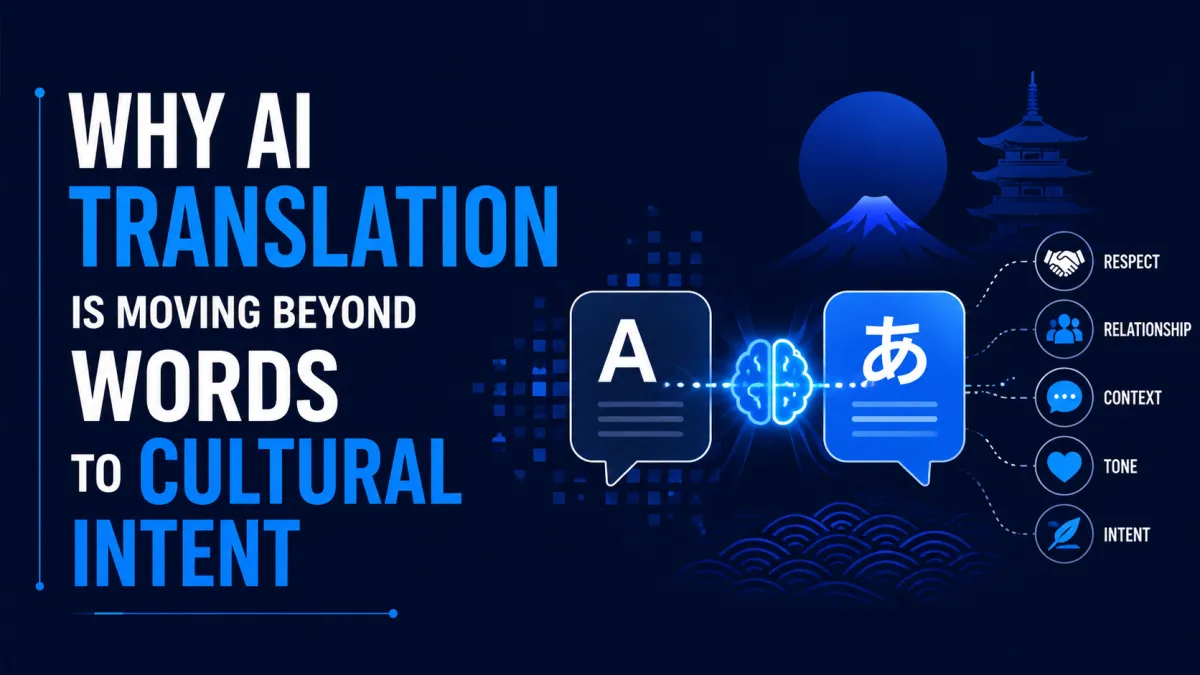
Why AI Translation Is Moving Beyond Words to Cultural Intent
Most people judge a translation by whether the words are correct.
Native speakers usually judge it differently.
They notice whether the message feels polite enough, too direct, overly formal, unintentionally rude, or simply unnatural. In languages like Japanese, these nuances often carry more meaning than the literal wording.
This is exposing one of the biggest limitations of modern language models. Large language models have become excellent translators, but they still struggle with something humans develop over years of social interaction: understanding why something is being said, not just what is being said.
Recent research from companies including Sakana AI suggests that the next generation of multilingual AI won't simply translate sentences. It will increasingly model cultural intent.
That represents a much bigger shift than improving translation accuracy.
Translation Has Become a Context Problem
For years, machine translation focused on replacing one sequence of words with another.
Neural translation dramatically improved this process, producing text that sounded more natural than earlier statistical systems. But even today's strongest models often make the same mistake: they assume every sentence has a single "correct" translation.
Human communication rarely works that way.
A customer complaint can be rewritten as:
- empathetic
- formal
- diplomatic
- authoritative
- apologetic
All may be linguistically correct.
Only one may be appropriate for the audience.
The challenge isn't vocabulary anymore. It's selecting the version that matches the social context.
This becomes especially difficult in languages where hierarchy, politeness, and indirect communication are deeply embedded in everyday speech.
Why Japanese Exposes the Limits of Current AI
Japanese is often cited because it requires constant decisions about tone.
The same request may be expressed differently depending on:
- seniority
- familiarity
- business setting
- customer relationship
- social distance
Many of these choices aren't explicitly written in the source language.
Instead, speakers infer them from context.
That creates a difficult problem for AI.
A literal translation may be grammatically flawless while still sounding insensitive or unnatural to native speakers.
This isn't unique to Japanese.
Korean, Arabic, German, Spanish, French, and many other languages contain similar cultural expectations, although they appear in different forms.
Japanese simply makes those expectations impossible to ignore.
Cultural Alignment May Become the Next Competitive Advantage
The AI industry has spent years competing on benchmark scores.
Translation quality is becoming harder to differentiate using traditional metrics.
Most leading models already perform well on factual translation tasks.
The next frontier is whether an AI understands:
- audience expectations
- regional communication styles
- organizational culture
- emotional nuance
- professional etiquette
For businesses, these differences matter.
An AI-powered customer support agent that sounds culturally appropriate is more likely to build trust than one delivering technically correct but awkward responses.
Similarly, global marketing campaigns increasingly require localization rather than direct translation.
The value shifts from language conversion to communication design.
This Will Influence Much More Than Translation
The implications extend well beyond multilingual chatbots.
AI systems are increasingly responsible for:
- writing emails
- generating documentation
- assisting customer service
- supporting international sales
- creating marketing content
- facilitating global collaboration
Every one of these tasks involves communication choices.
As organizations deploy AI across international teams, they will expect systems to adapt their tone based on audience rather than language alone.
This is particularly relevant for AI agents that interact directly with customers.
Future evaluation metrics may include questions such as:
- Did the response respect cultural expectations?
- Did it maintain the organization's communication style?
- Would a native speaker perceive it as natural?
Those criteria are difficult to measure today but increasingly important in production deployments.
The Future of AI Localization Is Behavioral, Not Linguistic
Research into culturally aware language models signals a broader transition in AI development.
Instead of asking whether an AI can translate a sentence, organizations are beginning to ask whether it can communicate appropriately within a specific cultural environment.
That requires models capable of reasoning about context, relationships, and social norms—not just syntax.
No AI system has solved this challenge completely, and human review remains essential for high-stakes communication. But the direction is becoming clear.
The next generation of multilingual AI will be judged less by the accuracy of its translations and more by whether users feel understood.
For organizations building global products, that distinction may become one of the most meaningful measures of AI quality.